Welcome

The eye is keen. The mind is thoroughly grounded. The goal is to maintain a sense of intellectual honesty while exploring the culture of criticism and evaluating creativity in all its glory.

Tuesday, August 24, 2010

Busting a Gut - part IV

Laughing ––

  • Part I, absurd. 
  • Part II, utterly senseless. 
  • Part III, slapstick silly.
  • Part IV, satire.

Satire is a rather dangerous sort of comedy. Frankly, it’s intent is to shame individuals, or society itself, into improving by using constructive social criticism through wit. The weapon of wit is truly a subjective thing and sometimes it carries a wallop quite similar to the bite of dog; rather than the more noble nibble of a sheep. In that case satire more closely resembles sarcasm and that kind of humour is generally down right mean.

I do believe Americans love satire ... at least those of my generation. I never thought much about it growing up but, now that I’m older and a bit more reflective, I understand the difference between Rowan & Martin’s Laugh-In and the original Saturday Night Live. For sure, good satire will offer lighthearted humour full of irony or parody, and follow that up with a serious after-taste. In simpler terms; make people laugh, and then encourage them think.

When I began creating the Wilderlife Series I intended to use satire to make fun of both the pompous art world as well as the smarter than me biologist types. That in itself was very easy to do, yet once my family and I began really exploring the imagination we sometimes went a bit farther than I ever planned. A great example is the two shrew-type critters. I believe it was Goldie who began the idea that we should create opposing cultures similar to the relationship shared between England and France. (Put this in historic context, if you will ... over the centuries those nations across the pond have been contentious neighbours who often sound like the Bickersons. What fun to play with that idea!)

Take a read and see if you get what I mean:


COMMON NAME: Great Horned Shrew

Species: Tres hornicus rodenteon. Other names include little big horn, half pint, wee body, shrewy wooy, and knuckle buster. The great horned shrew can be confused with it’s close relative, the grey horned shrew.

General facts: Great horned shrews are hyperactive omnivores that grow 1 and a half to 2 inches long from butt to nose and weigh between 5 and 7 ounces. They feed primarily on grass seeds, but also eat other things such as ear mites, noseeums, fly larvae, and rabbit. They are surprisingly successful pack hunters that can cleverly take down a 10 pound mammal. With an excellent sense of smell and hearing, the scout-rodent identifies potential prey and communicates direction to his fellow pack members using teeny squeaks and whisker wiggles. The pack will then position itself around the target and charge with a mighty lunge. In the midst of the frenzied activity, few who fall pray to a shrew-trap can escape.  Using razor sharp teeth and jaw pressure of 87 pounds, a large rabbit will be dismembered in less than 20 minutes. Contrary to popular belief, their horns are not used when hunting. Like dahl sheep, their head adorns are used when fighting for mates, communication, and back scratching.

STATISTICS: Great horned shrew live in colonies that range from 2,200 to 5,702 animals. They have a feudal social structure that is comparable to 12th century France. Basically, it is many mini-kingdoms controlled by one. The highest level of their society does not have to hunt at all. Serf hunters of the pack give most of their catch to the vassals, who give some of that catch to the lords, who in turn contributes a little bit more to the hierarchy’s cache. Generally speaking, great horned shrew have a snooty disposition, again relating to 12th century France. They have an unusual sense of family structure, appearing to be big on courtship and giving little regard to monogamy. It is difficult to tell the genders apart and statistical information on the animal count is nothing more than mere speculation. Their greatest enemy is the grey horned shrew that resides just across the river.

HABITAT: North America and parts of Canada. Resides just about anywhere it can get away with.  Most sightings have occurred in Quebec and the interior of Alaska. It is rumored that they were once abundant in Louisiana, most specifically in and around New Orleans.


** Morning Glory
    Gouache on Bristol Board


_____________________________________________


COMMON NAME: Grey Horned Shrew

Species: Nutralous hornicus rodenteon. Other names include english shrew, quarter pint, ye body, winston, and knobby nibbler. The grey horned shrew can be confused with it’s close relative, the great horned shrew.

General facts: Grey horned shrews are lethargic omnivores that grow 2 to 1 and a half inches long from butt to nose and weigh between 7 and 5 ounces. They feed primarily on berries, oysters, and other aphrodisiacs,  but also eat other things such as fleas, wild lettuce, green m&ms, and rabbit. They are surprisingly successful scavengers that can cleverly take food from their enemies. With an excellent sense of smell and hearing, they can detect the enemy approaching and run like the wind. The pack hunts only at night, taking full advantage of slumbering neighbours’ unguarded caches. During day hours this shrew never strays far from it’s home and behaves like simple gatherers searching for berries and other pleasurable things. Grey horned shrew are never seen alone and are easily identified by their never ending attentiveness to their mate. They are very affectionate creatures, constantly petting, doting, and caring for other members of their clan.

STATISTICS: Grey horned shrew live in colonies that range from 5,702 to 2,204 animals. They have a monarchy social structure that is comparable to 12th century England. Basically, it is huge kingdom controlled by one. The highest level of their society does not have to hunt at all, for it is adored by every member of the group who will gladly give all they own to the apparent lordship of them all. Generally speaking, grey horned shrew have a refined disposition, again relating to 12th century England. They have a traditional sense of family structure, appearing to be big on monogamy and giving little regard to courtship. All their nests are built near by the wildflower known as Forget Me Not. It is speculated that the scent of the blooms perform a major function during the mating season. Perhaps it is an aphrodisiac, or maybe it just looks pretty. The grey horned shrew’s major enemy is the great horned shrew, that resides just across the river.

HABITAT: North America and parts of New England. Resides, or has resided, in just about every region of the world. Most sightings have occurred in Victoria, on Vancouver Island, British Columbia, and in smattered locations throughout South Central Alaska. It is rumored that they were once abundant in Massachusetts, most specifically in and around Boston. Evidently, there still seems to be a thriving colony on the Faulken Islands.


** Procreation Congregation
    Gouache on Bristol Board

_____________________________________________

Saturday, August 21, 2010

Busting a Gut - part III

Laughing –– Part I, absurd.
                          Part II, utterly senseless.
                          Part III, slapstick silly.

Slapstick comedy is a shameless sort of humour that is considered lowbrow and better suited for children. As silly as it is, do you know what is the funniest thing about it? Answer: The pleasure of slapstick is universally shared among pretty much everybody I’ve talked with regarding humour ... which means nothing more than we all laugh at it.

The basis for this kind of joke is pain ... you know, people falling down, smacking into a brick wall, knocked in the shin with a bat, a potted plant falls on your head, a tumble down the stairs, a frying pan upside the head, or a slip on a banana peel and land on your butt kind of thing. I don’t know what it is exactly, but for some reason that sort of stuff just makes us laugh and laugh. We even laugh at ourselves when we are the victim of a smack or a whack or a trip, go figure.

Interestingly, and this is something I say in my own defense all the time, laughing IS a natural pain killer. I prefer to think that when I laugh at the bozo who fell down, I am actually expressing thoughtful support by giggling because I know laughter is also contagious and, like it or not, the boinked one will ease his own pain by laughing right along with me. I am grateful for the scientific study that gave me this excuse, and I’m sticking to it.

The term ‘slapstick’ actually describes a common stage prop used during the vaudevillian era and was, litreally, a piece of wood that had been split on the long side - like a sword with a cut all the way down the blade on the thin edge. When one guy whacked a second guy with the stick, the two pieces of wood slapped against each other and the impact sound was emphasized by the wood hitting against itself. What sounded like a wicked hit was actually rather harmless and pain free. But, the audience’s perception was audible inflicted pain and they roared at the idea of that.

Vaudeville was not the first to implement such a theatrical prop; it was just the most notable generation where that style of comedy was explored extensively and, because of technical advances during that age, the ‘golden era’ of black and white silent movies spread this style of comedy far and wide. Wacky characters flash in our minds whenever we hear their name: Charlie Chaplin, Laurel and Hardy, the Keystone Kops, and the Three Stooges. If we dug for the root of this goof-ball practice (pain via stick whacking as humour), we’d find a slapstick sort of prop at least somewhat present in Ancient Greece, Rome, even in the Middle Ages where rejuvenation of theater in church liturgical dramas had actors beating the devil right off the stage. Renaissance carried it forward with Shakespeare incorporating many chase scenes and beatings into his comedies. It seems like the halarity of pain and suffering is a primitive emotion that goes right to the bone of who we are, and it’s been with us since the beginning of recorded time. I imagine and believe, actually, that cave men whacked each other with a club just to hear the other clan members gawfaw at the pain ... I wish that were etched or painted onto a cave wall so my point would be proven without a doubt.

It has always been a big hit for children, too. Animated cartoons such as Tom and Jerry and Looney Tunes taught us all about how funny it was to trip a friend, then point and laugh as they lay on the ground crying. I got in trouble for doing that a lot as a kid. It took me a while to comprehend that the fun of the joke was the illusion of the thing and not the real hitting, and encouraging a friend to learn a stunt roll or a hollywood smack saved at least one of us from a trip to the principal’s office ... because his stick was not a slapstick and that bona fide butt-whacker hurt like hell. The point here is, no matter how lowbrow or simpleton one makes this sort of humour out to be, truth is it kept us kids playing hard while honing our minds to be sharp as a tack.

And with that, here is the wilderlife critter that honours the slapstick. Sit back on your whoopie cushion and enjoy:


COMMON NAME: Chipundale

Species: Jesterian smartassicus rodentian. Other names include tree clown, lil’ buger, chuck monk, Ivan and the punk. The chipundale  can be confused with it’s less humorous cousin, the chipmunk.

General facts: Chipundales are daylight omnivores that grow 4 to 7 inches long, including the bushy tail, and weigh between 2 and 15 pounds. They feed primarily on bird legs and nuts, but also eat other creatures such as bunnies, crickets, ants, locus, and butterflies. Highly developed senses of humour and irony allow this excellent tree climbing nut to annoy other members of its clan. It’s greatest advantage is keeping its predators amused long enough for the chipundale to get away. A forest prankster, it is not unusual to see one sneak up behind another and push him off a limb, or simply say ‘boo’  and then laugh as the unsuspecting butt-of-the-joke jumps with a start.  Apparently, the greatest prize of all is to actually force a competitor to fall to the forest floor.  The echoing cackle of their laugher can be heard on any given day. It sounds like ‘yuck, yuck, yuck’ (swallow your tongue when you try this).

STATISTICS: Chipundales live in dens called funhouses. Their homes are full of booby-traps that keep competing critters from stealing stored grub. Traps include, but are not limited to: false floors, stairs that turn into slides, doors that lead nowhere, and trick mirrors. It is unknown where the mirrors come from, however, they do say ‘objects are closer than they appear’ along the bottom edge. They have dribble glasses, flowers that squirt water, and whoopie cushions. Palm buzzers stopped being used weeks ago, and these forest rodents do seem to be fond of fake lottery tickets. Migrating along with the circus, these critters love using discarded clown wigs as bedding and furniture stuffing.  Their natural enemy is the paper cup. They often get their head stuck inside and the other chipundales laugh and laugh, seemingly too amused to help the critter out of his bind. Their mating habits are unknown ... we assume they are humorous.  For some unexplainable reason, our view of them always fades to black before the big finale. We do know they have litters, or clutches, of up to 89 off-spring, often including siamese twins.

HABITAT: North America and surrounding regions.  Resides along the normal migratory trails of reputable, or not so reputable circus troops. When over populated, they occasionally frequent county fairs and political rallies. As strange as it may sound, most sightings are witnessed by fishermen from Alabama.  Go figure.

Monday, August 16, 2010

Busting a Gut - part II

Laughing –– Part I was absurd. Part II is utterly senseless.


When you really think about what makes a person laugh you may come to realize that it’s not just a ‘joke’ that does it. Many things play a roll and I am one who has come to believe that the laugh should be associated with far more than simple merriment. There is no doubt that laughing feels good (unless you do it so much that your side feels like it’s splitting and your cheeks are about to burst), but is that all there is to it? Sigmund Freud wrote a general explanation regarding laughter that he called the Relief Theory, in which he summarized that laughter releases tension and psychic energy. Considering this, the theory explains why busting a gut can be a coping mechanism for any person who is upset, angry, or even sad. But, I’ll not delve too deeply into that part of the psychology of the laugh right now .... today we need to remain utterly senseless - or, in plainer words, insane. We’ll focus on the idea that when confronted with an inconsistency with reality any person can bring a successful solution by solving a cognitive riddle in a satisfactory way, and most of the time solving the riddle is what brings laughter and a sense of understanding.

There is a point that I understand well and attempt to conform my silly creations to, and that is a basic law of comedy which is called exactness. Exactness will never allow the audience to be confused because, if they are, they will never laugh nor even begin to understand the joke. Before I introduce you to the second Wilderlife critter, I will first illustrate a complete humour-communication-failure with one of my insane painted jokes. I call this cartoon Joe and the Artist, and it was created after I read a small newspaper article about a copyright lawsuit involving Philip Morris and Billy Coulton, the artist who created Joe Camel.


I put a lot of thought into this gag of a painting ... drug an old firewood chunk and some dried-up field grass into our living room; then bribed my husband to dress in a tank top, tuck his blue jeans into his motor-biking boots, then hold still as he knelt before and stretched his neck across the stump as though he were laid out for a chop. The insane joke here is that an artist, which (in a sense) is god-like, intends to violently snuff the life out of his own creation. The joke today does not work because the average viewer does not possess a full accounting of the real-life courtroom drama that happened nearly 20 years ago; and, since the time of my cartoon’s creation smoking has become public enemy number one. What was a play about copyrights and monetary gain from a creator’s tangible form of expression has turned into a nasty public statement about the dangers of smoking. That is an unfortunate turn of events for my cartoon and these days more people turn away in disgust rather than try to unravel the cognitive puzzle that is my image of Joe and the Artist ... the very European artist who felt quite cheated by the giant American company named Philip Morris (Joe was born in Europe in 1974 and was originally created to be a mascot for a French Advertising company. The artist sold him, and all his copyrights, for fifty bucks ... the fool).

What was re-confirmed most from this cartoon is that not every amusing thought has a long shelf-life. Social condition and controversy shift on a whim and what is funny one day may be offensive the next. Although, I have to say Joe and the Artist does bring me sick pleasure these days and I often chuckle in my own sadistic way ... when I’m watching someone uncomfortably spying this thing while they try to find a polite way to say it really sucks. We’ll talk about that sort of humour in a later post.

For now, my Wilderlife Series has proven to be resolved inconsistency for most people viewing it - even an image as insane as the creature we call the Lurky. This painting proves how the theory works in the case of visual humor. The joke is the insanity of a turkey and lizard combined and viewers will automatically try to understand what this picture is supposed to say, or doesn’t say, or implies. Thanks to movies like Jurassic Park and the vicious critter called velociraptor, the Lurky is not too far removed for comfort. I can not tell you how many times I’ve heard people explain the painting to me that way. Surprisingly, I’ve never heard the words, “that’s just wrong” associated with this piece.


COMMON NAME: Emerald Lurky

Species: Voloptar turkilearian rapteus.  Other names include glen, bob, o’brian green socks, and mayflower. The lurky can be confused with descendants of the velociraptor.

General facts: Lurkys are diurnal omnivorish creatures that grow 1 and a half to 3 feet tall and weigh between 40 and 60 pounds. With a wing span of just three inches short of five feet, they are capable of hitting 60 mph, or a tree, provided they can get off the ground. They feed exclusively on pansies and rabbits, but have been rumored to eat dandelions and slugs during lean seasons. Highly developed senses of touch and go allow excellent ariel dynamics that confuses and stuns its prey. Hunting only during the hours between 1pm and 3pm, Lurkys are seldom seen due to the siesta rituals of the Oasis regions in New Mexico and limited areas in Nevada. The main enemies of the Lurky are humans because they discovered the beast tastes a lot like chicken, and their feathers are highly coveted by show girls in Las Vegas and ritualistic Miatec priests.

STATISTICS: As ground nesters, the Lurky commands much space to spread their wings and protect their young. Wings are used as umbrellas, blankets, cozies, and sunscreen. Occasionally, young chicks can be seen atop the parent’s unfolded wings practicing their touch and go proficiencies. The average clutch is 2.3 eggs that are about 6 inches in diameter. They are highly prized in logging camps and back-woods resorts. The birds reach maturity at pubirdy, which is 6 weeks after they discharge their shells, and will quickly find a mate and remain monogamous throughout their very long lives. In the wild, Lurkys live an average of 27 and half years. They have never been domesticated because when they are separated from their mate they will die of a broken heart. Or some such.

HABITAT: North America and surrounding regions. Resides mainly in forest glens along the edge of botanical gardens. Most sightings have occurred in nooks and crannies in the Oasis regions, or in a drunken state, though a few have been seen partially sober. It is strongly advised you never look up during the hours of 1pm to 3pm for reasons good taste will not allow us explain. Also, avoid the fields beside the glens during those same hours. A 60 pound bird hitting 60 mph hour can command overwhelming damage should it hit you.

_____________________________________________


** Forest Glen
    Gouache on Bristol Board

When I recall the pleasure of making images and words for this series, Forest Glen holds one of the fondest moments for me. Me, Chris, and Goldie sat around late night at our print shop and simply laughed until we cried, each of us adding another outrageous trait or action to give our imaginary raptor bird. My family is so very funny and once we get started the concept of contagious laughter holds true. For me, that is one of the best things in life.

I chose to combine a turkey and lizard simply because I wanted to make the most outrageous combination of animals possible, and discover if I could make it even somewhat believable. Apparently I pulled it off.

Wednesday, August 11, 2010

Busting a Gut - part I

Laughing –– What a funny little thing that is. It’s a special, primitive, and universal language that can transcend all other barriers between human beings. Every culture laughs. Even some animals laugh. A good laugh is equivalent to a ten minute workout on a rowing machine. Some people laugh really loud and hard, others are rather quiet, while a few will only snort now and again. One thing is certain ... I love a good laugh.

I am on a mission for the next month or so to try to deeply understand the laugh. I want to know what makes us do it ... and whether or not I can learn to somewhat control it (either my own laughter, or others’). There are many reasons for the gawfaw and I’m going to begin with a thing I understand well.

The absurd.

Most of the time I am a wildlife painter and I’ve found over the years that most artists, patrons, and supporters take their jobs far too seriously. Granted, using the skill to help animals in rehabilitation centers, or educate city dwellers about life in the wild, is all a good thing. But, once in a while, we really need to let go of the seriousness. I had somebody tell me one time, when looking at my drawing of a duck, that I had the incorrect number of feathers at the base of the neck and I really ought to make gunk like that correct. Well, damn it man! I’m not generally a feather counter. I don’t ever want to be a feather counter. I just want to paint my pictures.

So, that’s what I did for years until, some time ago, I was one of those ‘fortunate’ painters who was ‘discovered’ by an international fine art print publisher. It was, I was told, every wildlife painter’s dream so I signed the contract with high hopes of building a reputation as one of the chosen best of the best. Funny thing (and not funny in a way that makes one laugh, funny, as in – ironic), my new publisher wanted me to be something I was not.  Robert Bateman. Carl Brenders. John Seerey-Lester. He sent tear-sheets and instructed me to copy subject and style. I didn’t take that sort of direction well and my five year contract was in jeopardy before this horse ever shot out of the gate.

What did I do? Since every wildlife painting I created during the life of the contract was to be first considered by the publisher, I opted to find a new sort of creation – and I went all out. My family and I busted our guts while we made up the most absurd critters, including scientific data, as well as a new public image for myself. I began with an anonyomous bio, which accompanied a ridiculous photo where I tried to sport a mullet-like hair-do with style.  I will not bore you with the long, full version but will, instead, just pull a couple of paragraphs to illustrate my pompous point:

__________________________________________________

Livvy - A Different Treasure of Another Kind

Like many wildlife painters in America, Livvy has come to her craft through an emotional and intimate familiarity with our natural surroundings. She was raised in the nearly uninhabited surroundings of Nikiski, Alaska and responded more directly than the average person to the fundamental appeal of the wild.  Unlike most sourdoughs, however, she expressed a natural aptitude for drawing and her relentless wanderings on paper weaved the larger story of her vicarious journeys. Though she continues to paint mainly wildlife subjects, the collection of paintings gathered for this volume reflect an extravaganza of sorts; a focus that is a little less on the typical, and a little more on nature as seen through the lens of the mind. Primary emphasis is placed on Livvy’s rich messages relating to her youthful foreground of local habitat that may be, perhaps, closer to her heart than the heritage of any other part of the world.

Today Livvy, who now lives in the sort of southern part of the Pacific Northwest, is a semi-public figure and the recipient of many compliments and accolades. She is regarded by many as a premier nature artist and fervent conservationist.  For others, she remains an enigma. However she is observed, her prime directive for her aesthetic compositions shall possibly serve as an inspiration to provide opportunity to explore more fully the complex beauty and sublimity of our own natural world. It is a mission she accepts with pleasure, vowing to always stay true to her brush above all else, for the beauty, peace, and truth found there have no equal.

Livvy says that her art has very much to do with perceptibility, which forms the basis for many beautiful wildlife paintings.  “It is hard to see an animal in the wild,” she explains, “Cuz they always run away.” Often, the only chance to get close is to postulate the harmonies of colour and texture, and then paint that and share the experience of being within the intimate world of the animals. As an artist, it’s important to take advantage of the creator’s biggest advantage and render the scene with such reality that the impossible becomes possible.

No truer words are spoken for Livvy, for her infinite patience and delight in caressing her brushes against the Bristol, or just caressing her brushes, give us all a glimpse into her moments in paradise. Most surely, if she thought more detail would make her work more beautiful, she would strive to visually articulate more detail.  In a sense, perfectionism is her disease and the consummate venue to allegorize her reverence for the wild and infinite beauty of nature and fantastical things within her.

                                                                                  –– Anonymous

__________________________________________________


My publisher blanched when he read my pompusly verbose new bio ... and I’m saving you an abundance of annoyance by only posting half of it here today. Still, as with him, I’m sharing with the bio a collection of twelve paintings which brought my point home. I will post them over the coming weeks, one by one, along with the 'scientific' data and story behind how it came to be.  Back in 1997 I was pained by the thought that for five long years I’d have to leave my natural inclinations behind and avoid painting straight up wildlife. Fortunately, I found a way to use humour to lighten my load. The beautiful thing about humour is ... laughter is a natural pain killer, and that’s especially true when one is dealing with a pain in your butt.


COMMON NAME: Polarcam

Species: Arcto humpteus camealious.  Other names include spitter, double do, snot rocket, magnum, and polar rover.  The polarcam can be confused with the middle eastern desert dog.

General facts: Polarcams are arctic carnivores that grow 8 to 12 feet tall (including the humps) and can weigh up to 1380 pounds. They feed primarily on arctic hare, but also eat other creatures such as ice worms, arctic fox, seal, and the mighty beluga whale. Their greatest and most feared weapon is their projectiling spit-balls. Whether hunting or defending themselves, they can quickly work up a mouth full of saliva and spit with remarkable accuracy. The subzero temperatures of the arctic region almost instantly freezes the warm mouth fluids and the resulting flying balls can range from 1 to 4 inches in diameter, weighing up to 3 pounds each. With an amazing target accuracy of 98.7 percent at 25 yards, the polarcam fears very little and never tolerates anything found near his home range. The distinctive double humps act as a food cache that holds devoured meats and allows the beast to live up to three months between meals. It is speculated that arctic penguins once shared the range of the polarcam, but found themselves defenseless against this large and aggressive animal. They can run nearly 53 mph hour and may swim up to 4 miles in ice laden waters.

STATISTICS: Polarcams sleep standing and have no recorded social order at all.  Always solitary, it is unknown how they reproduce or develop. No female has ever been seen and it is speculated that they live in a harem type situation in some sort of ice cave, perhaps being tended to by a dominant male, or servant of the dominant male. In one reporting, a secret  mission brought a researcher within 25 yards of a large male that was frolicking in apparent play on a field of drifts. The 8.3 minutes of satellite feed showed a delightful animal at ease. Unfortunately, the beast detected the human and much desired analyzation of the spit ball phenomenon ensued. The scientist has not been heard from since.

HABITAT: North American Arctic and surrounding regions. Resides mainly on the arctic coastal plain and most sightings have occurred around and about the Point Barrow area. It is strongly advised to never approach this animal. It is orally recorded that 13 humans have been killed by the polarcam and wounds inflected on survivors appear quite similar to a gunshot wound from a 357 magnum pistol.

__________________________________________________

** Sunrise on the Arctic Coastal Plain
     Gouache on Bristol Board

In 1977, at age 16, I was allowed to visit the Arctic Coastal Plain at Point Barrow. One of my fondest possessions is the certificate that proves I crossed the Arctic Circle during a time when non-oil-industry citizens were not permitted. What impressed me most was the frigid cold in July and the truth of the midnight sun. The place was absolutely desolate. I felt so tall in a land without mountains or trees, standing on frozen ground and spying the curvature of the earth from my five foot five viewpoint. No plant grows over six inches tall there. It is a frozen desert, really. I wasn’t allowed to explore and did not find any animal life  at all. I could not get over the idea of a frozen desert, though, and imagined the perfect animal had I only been permitted to go find it. When creating the crazy wilderlife in 1997, I dug up the memory of that place and included a Polarcam for fun. It is true. I don’t like to paint what I have not seen, yet sometimes my mind supplies pictures far  too fantastic for my own good. I can’t help it.  I am Alaskan.

Monday, August 2, 2010

Changing Your Stars


Chelsea Clinton got married yesterday. Lindsey Lohan sat in jail. Mel Gibson’s chaos has quieted down a bit. Michael Jackson conquers death with a new album due out in October. And, I’m wondering what to write about today.

I look around and I’m just not inspired with the cultural side of life these days. I’m apparently going to continue to sound like a broken record, pining for the good ol’ days when culture and class ruled everything. I am pondering this because I ran into a  dilemma this week in respect to what would be a good and appropriate movie for my six and half year old grandson to watch with me. The choices are tough, I think.

Foremost, I am boycotting animation. I’m sick of ‘em. I want to see real people performing amazing scenes. I want to believe in the magic of the human spirit again. I want my grandson to experience that, too. For him, at his father’s he’s been fed animation and superhero crap all his life; bombarded with flashing weapons, sped-demon vehicles, and monsters made from machines or hatched from a fiery dragon’s lair. In the old days our heroes were cowboys, astronauts, explorers, muskateers, firemen, and cops. I often recall what my daughter tells her son again and again, “No matter how many times you dress up like Spidy, you are never going to stick to the wall.” Doesn’t that just say it all?

When I first approached my daughter with my dilemma I was taken aback by the movie she suggested. I love the film and think it’s one of the most cleverly written adventures around, yet I thought it might be a bit too rough and mature for a little one. She reminded me of the movies and ‘toons the boy sees at his dad’s. Considering that, I suddenly found myself wondering if he would be too bored to really get the point of this tale. That wouldn’t be good, for the point of the story is truly the treasure of it. We grabbed the reins and charged ahead with pizza and rootbeer floats, ready for our movie night. I showed my grandson the DVD box and waited for whatever reaction he might have.

The tag-line of the movie certainly helped the little one’s interest:
“From peasant to knight; one man can change his stars”. Thanks to the Backyardagains he knew what a knight was, but he had to ask what it means to change the stars. What a wonderful opportunity to begin to help him understand the beauty of hopes and desires, and how we have the will to charge towards them and make our life whatever we want it to be. I quickly gave him a snippet of the story thread ... a poor boy (William) is given to a rich man, to be his servant, and he will travel the world and learn as he works as a valet. His father sacrificed by giving his only son, offering him hope and possibly a better future. As the boy got ready to leave, his father encouraged him, “Change your stars and live a better life than I have.” William sadly said,  “Father, I am afraid, I won't know the way back home.”  Father replied, “Don't be foolish, William, you just follow your feet.” Then the story really begins.


That is all I told my grandson about the movie we were ready to watch. As he walked across the living room to sit next to his mom the soundtrack and menu screen began playing. Rock music pounded, knights in shinning armor charged along the rail and rammed lances into the chest and heads of opponents, unseating them. In slow motion the lance tips exploded into splinters while the riders careened and fell. Some hit the ground. Some lay back on the horses’ rump. Another slid along the rail. My grandson stopped in his tracks and simply stared in awe at the looping promotional opening. He did not move until we stopped the menu. Once he found his seat he breathed a reaction, “This is going to be so cool.”  I thought to myself “That answers that ... this movie has his attention, now can it capture his heart?”

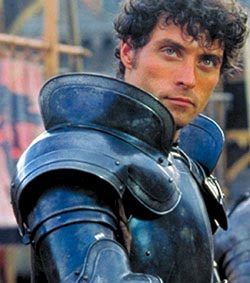
The production I am talking about is, of course, A Knights Tale. I’m not going to spend my time going through the plot or providing a synopsis, and there’ll be some spoilers in here, too. I figure most have seen this flick and, if you haven’t, what’s wrong with you? It’s got great costumes, adventure, heroes, a bad guy, a princess, and head-banging music to boot! Sure, there are TONS of continuity issues ... like the scene where Geoff has some cloth stuffed up his left nostril to stop a nose bleed, then it switches to the right side in the next shot, then back to the left. Or, during that last joust the horse’s armor switches from old leather in a close up to the new metal one in the next take. There are so many continuity errors that you could make a drinking game of it, which is why it all seems in spirit with the movie’s intent anyway, so who cares? This movie is just plain ol’ fun to watch.


What makes it an interesting choice to share with a little one was my daughter’s reasoning for allowing it. My first instinct was to say, “No way!” simply because it carries a PG-13 rating. But then, movies from even a few years ago where rated by stricter measure than they are today. I understand that. I’ve seen recent made-for-kids-movies in animation that utterly shocked me when considering content and choice of words, so what do I know about ratings? My daughter put it plainly: A Knight's Tale is all about not having to worry about sticking to a wall. It has a hero that is working to better himself, and he is just a human. He doesn’t need a special suit to be exceptional (although, his new fancy armor might actually qualify!) This hero (who is William) decides what he will do to change his stars, then practices for perfection and competes in sporting events to better his standing and financial condition. He doesn’t just take it, he earns it. Along the way he consistently shares with his friends. Sure, the script has the ‘s’ word in it (that’s ‘s’ for Shite, which is cute, if you ask me) and a couple for God’s sakes - I think there is a BS, too. All in all, it really is tame in the language department.

The bad guy (Adhemar) isn’t really that bad when compared to the bad guys that my grandson sees at his dad’s in other sci-fi adventures. He is a jerk, yes. And, he cheats to win. He’s an elite snob. But he doesn’t try to rule the universe and he wasn’t enhanced by any super power what so ever. More importantly, he doesn’t kill. In one scene where he ‘tips’ his lance with a hidden sharp point, and that point drives through William’s old armor at the shoulder joint, and the armor is removed after the run, there is only a small amount of blood and it’s obvious no life threatening event took place (another continuity error in this scene - when first shown, the padding under the armor has a hole with blood around it, moments later the hole is gone and only a little blood remains).

We do see a naked man’s butt from behind and from the side, but it’s done in a way that’s not shocking and no frontal nudity shows at all. The character reinforces well the idea that people should not be naked in proper society, and teaches the lesson that gambling is bad for a guy. One can, quite literally, lose the clothes right off your back. My grandson vocalized the moral lesson learned right after the gambling in town scene. I was impressed at how well he understood the concept, relating how unfair it was for the gambling friend to expect someone else to pay his way. As the boy said .... that’s just not right. The character learned and behaved quite admirably the rest of the movie and my grandson noticed that.

Of course, how could I mention this movie and not talk about the music? That part of this creation, I think, was brilliant and I knew it would give my grandson the emotion of the story, especially if he couldn’t understand all the words that were being said ... which many times was the case for him. Take, for example, the thread that asked early in the film, “What do you mean, dead?” The reply simply stated, “The spark of his life is smothered in shite. His spirit is gone but his stench remains. Does that answer your question?” Combine those clever words with a strong English accent and you have gibberish a child will not understand. My grandson asked me, “So, is he dead?” To which I replied, “Yes.” Early in the film we had to clarify what was happening.  Soon, though, the intent and story shone through well enough for the boy to understand what was happening.

I imagined this movie would do for my grandson what Romeo and Juliet did for me as a kid (That movie also showed a butt, by the way, go figure). If the story was filmed perfectly, and the actors played their parts naturally well, then a good understanding of the tale will come, even when verbal comprehension is lacking. That did happen with Romeo and Juliet for me, and it happened for my grandson in A Knight’s Tale.

The music in the film gave everything to the emotion of the players. Watching fans in stands at a jousting match as they clapped and chanted along with Queen, singing  We Will Rock You loudly; or seeing William and the Princess dance to David Bowie’s Golden Years was rather funny, considering the costumes and such, yet it definitely enforced the attitude of the people in their time. We related to the emotion immediately and it didn’t feel weird at all. Just ... funny ... and entertaining. Brilliant. If they would have played a renaissance ditty my brain would not have gone to the energy driving rhythm that fans produce at sporting events. It was important we felt like we were working our way to the superbowl of the day and this film did that better than ever.


In the end, my grandson said that was the best movie ever. It’s his new favorite and he’s said a couple of times since that he is going to change his stars. He may not totally understand what he is saying, but he’s got the idea that he can control his life. I think of the line William’s friend said to him when he first heard the plan for future glory, “We're the sons of peasants. Glory, and riches, and stars are beyond our grasps. But a full stomach, that dream can come true.” We will never better ourselves with that attitude, and I think my grandson understands that on his elementary level. My tough job now is to find more entertaining movies to watch with him that will reinforce it.

** Don’t forget to fast forward through the credits at the end. There is a fart joke that really captured the little one’s funny bones ... we had to watch that little snippet 4 times.

Saturday, July 17, 2010

Ghosts of Artist Past

Sometimes I read movie reviews and wonder how a person gets a job like that. How can they be paid to put words to paper that bash creative ones, or pump-up others to an insane degree? More importantly, why is it that a movie’s success depends on the critics at all? Couldn’t a great movie withstand the hoopla of critic bashing and still perform well? Unfortunately, most of the time they don’t, especially if that movie was not produced in Hollywood. I’m going to introduce to you what I think is a great movie that critics have soundly trashed. There will be some spoilers in here, but knowing parts of the story will not ruin the movie for you. This film is fiction based on truth and I think the human behavior aspect of it is simply priceless.

Goya’s Ghosts (2006) has several elements that made it attractive for me.  First positive element: It is a story told from an artist’s point of view and that’s a natural interest for a mind like mine. I love art … particularly art history.  Granted, Goya is not one of my favorites – I find most of his work repulsive and dark. But, why wouldn’t it be? He lived through the Spanish Inquisition and saw things few humans could stomach, so of course his paintings colourfully depict brutality and nightmarish visions.

Francisco Goya is fascinating in the sense that he is regarded as both the last of the Old Masters and the first of the moderns. He was a painter of royalty on the one hand, and a macabre printmaker on the other, whose prints created images depicting, what he called, “...the innumerable foibles and follies to be found in any civilized society, and from the common prejudices and deceitful practices which custom, ignorance, or self-interest have made usual.”  They were very dark visions.

The movie does a fabulous job showing the artist working at his craft ... it is played so naturally that you don’t realize what you are seeing. Printmaking, for example, is shown step by step with process explained through doing. The same holds true for oil painting and sketching. As an artist, I appreciate a certain ‘realness’ when art production is shown and I like to understand how things are made. Goya would have painted just as it was played for the movie – it’s a very traditional process that has nothing to do with the modern directive of inner visions or personal emotions. It is always delightful to watch an artist properly work in the context of actual historic processes.

Second positive element: The movie was directed by Milos Forman. A few of my all time favorites where directed by this man and his sense of visual interests and story-thread certainly appeal to me … One Flew Over the Cuckoos Nest. The People vs. Larry Flynt (a surprisingly good movie). Man in the Moon. Amadeus … Every one of these is a psychological study of human condition and reaction. I did not doubt that Goya’s Ghosts would deliver in that respect as well.

After a few Milos Forman movies I found myself wondering what it was that drove him to concentrate so intently on the psyche of an individual human mind under stressful conditions, and how it relates to others’ minds as they weave and interact through life. Most notable in his history is the truth that his parents died in a concentration camp under Hitler’s regime. Could that be his driving force? Perhaps. Certainly, I’ve never seen another who could so effectively develop a stressed character like Milos can – a character that is intensely portrayed by the subtlest of gestures, the nuances of body language, the inflection of vocal tone. I do not understand how he draws this quality from actors, he just certainly and consistently does it.

Third positive element: The movie was produced and filmed in Spain, not a Hollywood production. Hollywood can tire me sometimes, with their fast paced and visually intense productions – especially with epic historical dramas. I do enjoy costumes and panoramic sets, though sometimes those can overwhelm the story. This tale was about an era that was grungy, harsh, yet beautiful. Having Spaniards tell  me about it would add a bit of authenticity, and I liked the thought of that. It could feel grand without trying so hard and every detail in the backdrop could be just right. I was eager to experience Spain.

Forth positive element: Critics absolutely hated it.  I think it is one of the most dissed films I’ve ever read about in reviews (right up there with Amelia). None complained about the acting, nor the costumes and sets, in fact they liked that stuff. They just expected more and complained that it was undercooked. I don’t know what that means.

Here’s the truth about this film. It’s more accurate, historically, than most any film out there. There were only two glaring errors that I could see: One, the film begins in 1792 with the inquisition examining the “Los Caprichos” etchings. Goya did not create those until 1797. Two, when Goya unveiled the unflattering portrait of Queen Maria Louisa she was deeply offended and huffed out of the room. In reality, she loved the painting so much that she promoted Goya to first court painter. Both of those twists on reality where done to direct the story certain ways and I got through them without complaint. This story wasn’t a biography of Goya’s life and career. It was a study in human behavior and it involves three characters that are figuring out how to survive a time of extreme chaos and turmoil.

Visually, everything worked. Natalie Portman was cast as Ines after Milos Forman recognized her likeness to the girl in Goya’s painting “Milkmaid of Bordeaux”. She played a wealthy merchant’s teenage daughter whose portrait was painted by Goya, and who also sat for him as a model for angels in public murals and such. Portman does her part so well one could say she actually plays three roles in the film … pre-Inquisition Ines, post-Inquisition Ines, as well as her grown daughter, Alicia. There is a certain madness that Milos seems to appreciate and showcase, and Portman naturally provides that element to the film. She does hold a bachelor’s degree in psychology (Harvard) so I suppose her mental probing of the character would be the expected thing for her to do. She does seem to delight in the insanity of it all. There are times when you watch and think, man, the girl is completely mad and moments later she comes across sharp and clear, very aware of what is happening in her world. She sort of fades in and out of reality as the story moves along, in a not so obvious way. It’s brilliantly played and rather charming, in a weird kind of way. I ended the film feeling empathetic for the Ines, and loving her for all her madness. It’s funny … I reflected Goya in respect to the girl and found myself thinking about her for days after I watched the movie.

As for Goya, Stellan Skarsgrd looks very much like the painter. What I enjoyed about him was the complete normalcy of the man, both in appearance and in action. He was simply a painter who networked and searched for whatever commissions he could find. He was not a handsome and dashing Spaniard (as Hollywood probably would have cast him), just an average looking fellow who finagled himself through the chaos. He was portrayed as decency incarnated, which is everything I imagined Goya to be.

The third arm of the triad of characters is Lorenzo, played by Javir Baldem. Lorenzo is a person that is easily hard to take, yet as his character developed I began to understand his motives, and I did wrap myself around his persona before the movie was through. I liked Baldem in this role … a lot. He has a nice perspective on his job as an actor, once saying, “I truly believe that what I would like to portray on-screen are human beings, and human beings usually are not as handsome as movie stars.” Again, it’s all about personality studies and this movie was perfectly cast. Just watch the transformation of Lorenzo, from the opening scene to the last ... it is an astonishing journey of a man searching for conscience of faith.

The historical setting for this movie is huge. We experience the rebirth of the Spanish Inquisition, then turmoil at the end of Catholic rule as Napolian’s army invades and conquers Spain, and finally England barrels in and frees the Spanish from French occupation, and the liberated ones bring back Catholic rule in the end. What a waste through war, is what we see, and all things that turn around come around again. Goya’s etchings, which are shown throughout the movie, reflect things he witnessed – both the brutality of war and life in 18th century Spain. What Goya drew and painted is shown on film and whether you realize it or not, his eyes directed Forman in respect to set, just as Forman’s mind directed the psychology of it all. And, throughout that process, the three primary characters are continually finding each other’s orbit as we walk through this truly disturbing part of history.


I wonder what critics are thinking sometimes. Are they more concerned about a movie being enlightening, or cutting-edge, or faster or brighter or louder or more animated than the last one, or … what? What does under-cooked mean, anyway? The movie is almost there? It’s not well exicuted? One theme I caught through all the reviews I read was that every one of them missed the entire point of the film.  This is NOT about Goya or his muse. The title even states that clearly. It’s about ghosts. Not Goya’s ghost.  Goya’s ghosts ... more than one haunting person that belonged to the man. It’s not a history lesson about the ups and downs of the Spanish Inquisition, either, or foriegn occupation or political upheaval at all. A ghost is not events or time or space or subject matter. It’s a haunting person. More than one is haunting people. … and haunting generally indicates a troubled soul ... unable to rest.

When watching a movie like this, which is really a movie about pshychological evaluation/penetration, I find myelf examining things like being ‘put to the question’. What would I do should that have been me? Whould I say I love pork after all, or that my mother was a monkey? Or would I hold faith so dear that I’d suffer the pain? I must ponder piety, morality, civic duty, and basic survival to find that answer. And even then, I know I would have to live it … to feel the pain for the truth of it all is more than I can imagine.

Grasping this concept is not hard. Goya was an artist who chronicled a time. His paintings and drawings share with us what touched his heart through eyes that saw things few ever see. His ghosts are with us today – on his canvases.  He gave us souls who struggled and suffered and most did not survive. His people. His country. Ines could easily represent his homeland as a victim who never gave up. Lorenzo would be the heart of the country that forever searched for conscience. And Goya is the steady and decent soul.

You must look at this movie from an artist's eye and it will make more sense than any critic can imagine.

Sunday, July 4, 2010

It's Not Easy Being Green

I saw something very strange the other day ... it made me stop and stare in a way that I knew was impolite, but I couldn’t help myself. Walking along the sidewalk was a young man, somewhere between the age of 15 and 22 (It’s hard to tell these days). He was very skinny and looked like he’d never had a healthy meal in his life. The pants he wore were baggy-assed jeans, where the crotch came in at the knees and boxer-shorts stuck out the top (still showing butt-crack, go figure). His body looked twice as long as it should have been, and his legs appeared stunted (reminding me of Dorf, that very funny character Tim Conway used to perform back when). I wasn’t sure if his slouchy posture had to do with simple laziness, or if it were an effect caused by trying to keep his pants up (either way, when that kid gets old he’ll be shaped like a letter ‘c’, no doubt). Adding to the silly effect of body proportionment, he walked with his legs spread as far apart as possible (which wasn’t that far - his crotch was at his knees, for cripe’s sake), not bending his  knees at all ... just a waddle, like a penguin out of water. I actually laughed out loud for a moment.

As I watched him I thought, “How strange. Is that good looking today? Does he gaze in a full length mirror in the morning before he goes out and say ... damn .... I’m hot?” And then I wondered, “What is wrong with young people today?” That frightened me because suddenly I sounded just like the old people did when I was a teenage girl. Crap.

As usual, one little visual like that can make my mind ponder and cogitate so many different things. No matter what angle I thought about, things always came back to a notable point. I was trying to figure out exactly when it was that our sense of good taste collapsed.

Good taste is relevant, I know. So are good art, good movies, good books, good music, and anything else made from a creative mind. I had this debate in collage years ago, where an art history professor tried to convince me that the isms of our times were brilliantly conceived by exceedingly enlightened individuals. I thought not then, I think not now.

But, let’s think about this kid for a moment. Let’s average what I thought and say he’s 19 years old.  What was it like for him to grow up? He would have been born in 1991. He would have been terrified at the year 2000. (Y2K, remember?) He would have grown up with computers and 180 or so channels on his tv. In school he would have sat at round tables with 8 other kids and the smart one would earn the grade for them all (this kid wasn’t the smart one, I could tell - and yes, I’m profiling - that’s ok, too). Political correctness would rule his day and dooms-day prophecy regarding earth and warming and destruction would all pick at his little brain. The only presidents he would have known were named Clinton or Bush. His early years were much different than the early years I experienced.

I was born the year the Berlin Wall was erected. I was terrified of the Russian communists and the cold war kept our bomb shelters fully stocked and loaded. Computers were a fantasy that blinked and blipped on Star Trek; and I typed on an IBM monster of a machine learning finger positions and speed without errors (I could compose and type a formal business letter before I hit puberty). Television, on a good day, gave us 3 fuzzy channels and programs made family friendly the only game in town. In school we sat at single-student desks, in neat alphabetically ordered rows. I even had to take etiquette classes where I learned table manners and how to eat soup without slurping. Polock and Irish jokes were heard daily and dooms-day prophecy regarding earth and cooling and destruction would all pick at my little brain. The presidents I knew were Nixon, Carter, and Reagan (kind of a conservative, liberal, conservative treat; where Carter was the gooey center between a couple of really tough cookies). But, there was something else about my childhood that is missing for people like that 19 year old I saw wabbling down the sidewalk.

When I was in third grade a visitor came to our school and performed a puppet show for us kids. It was a charming presentation; funny, thoughtful, and held my attention better than most things could. The puppeteer’s name was Jim and he was promoting a new show that would begin airing on television soon. He wanted us to tell our parents about it, and hoped we would watch. After his performance we were allowed to go speak with him if we wished; ask questions and look closely at his puppets. He sat on a folding chair near the middle of a large gym. Most kids sprang off the bleachers and headed for the playground, running widely around the fellow who just spent a good while entertaining them.

I was very curious about the puppets and shyly walked over to the bearded man. “Hi.” he said as he smiled at me. “Hello.” I awkwardly replied, very quietly. I wasn't comfortable talking with a strange bearded man and he could tell. So, he switched his voice to the puppet’s on his right hand, and the imagined creature with his happy-go-lucky attitude spoke directly to my face. “What’s your name?” the frog asked me. I blushed and tried to stare at my feet as they shuffled. But, I couldn’t help but look at the puppet. It was making faces at me … cocking it’s head and puckering and crunching it’s nose. “I’m Kermit. Did you like our show?” I shook my head yes and found myself really rather amused by this ... sock of a thing that somehow seemed alive.

My shyness was lessening as I leaned in and tried to see how it was made. The frog leaned into me and began checking out my head. Startled, I jerked back and shot a quick glance at the puppeteer. He was pretending not to see me and I was getting a bit annoyed by it all. I did not like being teased, so I glared at him, furrowing my brows to really let him know I didn’t like him after all. The puppet raised his voice a little, “Hey! Can I ask you something?”  I looked back at the frog who appeared to be staring at me, tilting his head a little while he waited for me to answer. After a moment, I nodded a little yes, feeling more embarrassed and hoping none of my school friends were seeing this. “Why’d the elephant sit on the marshmallow?” he asked. Paleeeze … I thought … that is the stupidest thing I’ve ever heard. I pursed my lips and stared at the puppet, not saying a word. “Huuuummm....?” the frog urged me on. “I don’t know.” I finally whispered. “So he wouldn’t fall in the hot chocolate!!” Kermit joked, then he laughed and laughed, mouth open wide as he bounced, his arms flying about. It was infectious, and before I knew it I was giggling with the frog.

When he calmed from his own self-amusement, he began chatting with me in a rather adult way. “What do you like to do,” he asked? “I like to draw pictures.” The conversation went on as I explained how I found master paintings, and how I liked to copy them. And I wanted to grow up and be a master painter, too ... even though I was a girl and everyone says girls can’t do that. We actually dialogued as the puppet flowed with expression and questions for me. Kermit gave me some really good advice. He told me, “Do what your heart wants you to do. No matter what anybody says, your dreams are yours and if you think you can do it, then you can do it; even if you are different from other people who paint. That’s ok. Look at me. I’m green and you still talk to me.”

Somewhere during our conversation I ended up on the puppeteer’s lap and became so engrossed in my moment with a very grown-up cloth-frog that I didn’t notice anyone else in the gym. Something snapped me back to reality and I looked around, suddenly realizing that very few people were there. I was the only kid left. The puppeteer was smiling with the kindest of eyes as I timidly said to him, “It’s just a ... puppet.” And Jim said, “A puppet that tells the truth.” I hoped off his lap and said goodbye to the frog, promising them I’d always remember and follow my dream. And Jim Henson rubbed the top of my head and encouraged me to keep practicing my drawings so I would become the painter I wanted to be. And I did practice harder because I believed them … the frog, and the man that could make it talk.

I watched the first episode of Sesame Street because Jim would be performing Kermit and I loved to watch the magic of a new way of puppeteering, not to mention I felt like they were my friends. I saw every show I could, and was delighted to share them with my children when they were small. Grover taught us all so much, and Grouch and Cookie Monster were simply delightful. We ended up watching full featured muppet movies and a prime-time adult comedy show. The success of the muppets was historic and astounding, and it proved to me that every word Mr. Henson shared with a little 8 year old was true.  He became the greatest and most well known puppeteer in the history of the world … because he lived what he preached.

And then, in 1990 at the age of 53 ... he died unexpectedly. I was stunned. I couldn’t imagine life without Kermit and I spent some time reflecting on why I was so incredibly sad. I was lucky to have met them when I was young, and I felt a certain pride in all the successes that Mr. Henson found. He wasn’t family, but he sure felt like a friend.

My kids were young enough to still appreciate his company’s work and I tried to remain open to the idea that another voice was playing Kermit. I’d have to bite my tongue when the frog appeared. It wasn’t my frog anymore. This one would belong to a new generation of people, not mine.

Sometime later I saw Kermit being interviewed by several people, among them was Jay Leno. I don’t like Leno, I find his humour sexist and crude and, frankly, I can live without it. Not surprisingly, he could bring out the worst in the new Kermit. Sex jokes and nudity humour was unbecoming for the frog and I’d get angrier each time I saw stuff like that. I stopped watching anything Kermit or the muppets a few years after Henson died, and I’ve never regretted it. I rather like the frog and man I met when I was a kid and I prefer to remember them that way.

How does all this relate to the 19 year old and what he never experienced as a kid? It’s really simple, in a complicated way.  Our culture has become such an ‘anything goes’ place that dress or hair or tattoo, or whatever, can’t shock the meekest of us any more. Sex has infected every aspect from movies to videos  and books, and even children’s show characters. People are the complete opposite of beautiful, in looks and behavior. It’s like we’ve given up sensuality for dirty nudity and it’s come to the point of ‘who cares?’ anymore. They’ve made viagra for men to get them excited, and now they’re developing it for women, who need the sensuality more than ever in this very crude society. The fix isn’t drugs or pills or dirty naked people. The 19 year old may never figure this out, because all he’s ever seen is this modern side of chaos. That’s too bad for him. It’s pretty nice strolling on the beach, holding hands, talking sunsets with a person you love.

There was a time when clever words or general appearance invited appreciation and respect. And, those of us being inspired had a better life because our heroes cared about us and taught us well. I would bet dimes to dollars that the 19 year old’s heroes only care about themselves, or their own fame and how much money they can make from absolutely no talent. I hate to sound like the old people of my youth, but I’m saddened by what I see out there.  Kids, like the 19 year old, who have very little respect for themselves, spend most of their time with a ‘bud’ in their ear, a video on their ‘pod’, and talk only about winning a never ending virtual game of fantasy war. Their world is violet and ugly, in an imaginary way, and that sort of creativity is destructive as hell. It certainly doesn't help it's students become the very best that they can be and with those thoughts I say thank you, Jim Henson, for inspiring so many little ones while you were here.