Welcome

The eye is keen. The mind is thoroughly grounded. The goal is to maintain a sense of intellectual honesty while exploring the culture of criticism and evaluating creativity in all its glory.
Showing posts with label Movies. Show all posts

Friday, September 24, 2010

Two for One - part II

I had to watch the second Affleck movie a second time since the double feature night of quite a while ago. It’s not that this movie is bad, nor that Affleck did a terrible job ... it actually is, in my opinion, one of his best performances. As I said in part one, I think this movie helped me understand what it is that I don’t care for with Ben Affleck’s acting. There is a thing I call ‘regional nuance’ that everybody takes on. For me, I am a northern girl with about as much social class as a rock. For Affleck, he’s an east-er who has a certain polished sense about him. Perhaps it’s the way he speaks, the slickness of his hair, the stylish way clothes hang on him, or maybe his voice just isn’t quite low enough to feel truly manly and commanding. Maybe it’s a combination of all those things. Whatever it is, the aspects of regional nuance helped make this movie more enjoyable for me simply because I believed all the characters the performers played. Yes ... even Ben Affleck. But why have I not been able to write about it?

As I batted excuses around in my brain this week I believe I came up with the reason. Honestly, I think this movie hit too close to reality for me. Many things written into this drama that were meant to twist and surprise the viewer are part of our everyday way of life, and my moments to escape took me nowhere but to the here and the now. After the movie, I think the first thing my husband and I said to each other was, “Why the hell can’t we find a reporter like that today?” And then it hit me .... that’s what they WANTED me to think! All the cliche good guy/bad guy stuff is in our face and I refuse to play into the emotions of military bad, newspapers good, corporations bad, politicians slimy, bloggers bad, police stupid, uhhh ... wait ... what was that politician slimy part? I might buy into that! Seriously, though, if you forget any sort of agenda and simply follow the tale along, the movie is entertaining and thought provoking.  I don’t mean social conscience sort of thought provoking – I mean once all the pieces fall into place I had to sit and ponder to try to figure out who in the story knew what and when .... especially the politician’s wife. I enjoy being intrigued that way.

Russell Crowe and Ben Affleck play their parts well in State of Play
The movie I’m talking about is called State of Play (2009). It stars Russell Crowe as a street-smart Washington D.C. reporter (Cal McCaffrey), Ben Affleck as the slimy congressman (Stephen Collins), Rachel McAdams as the feisty little blogger/junior political reporter (Della Frye), Helen Mirren as the totally in control ruthless editor (Cameron Lynne, of the Washington Globe),
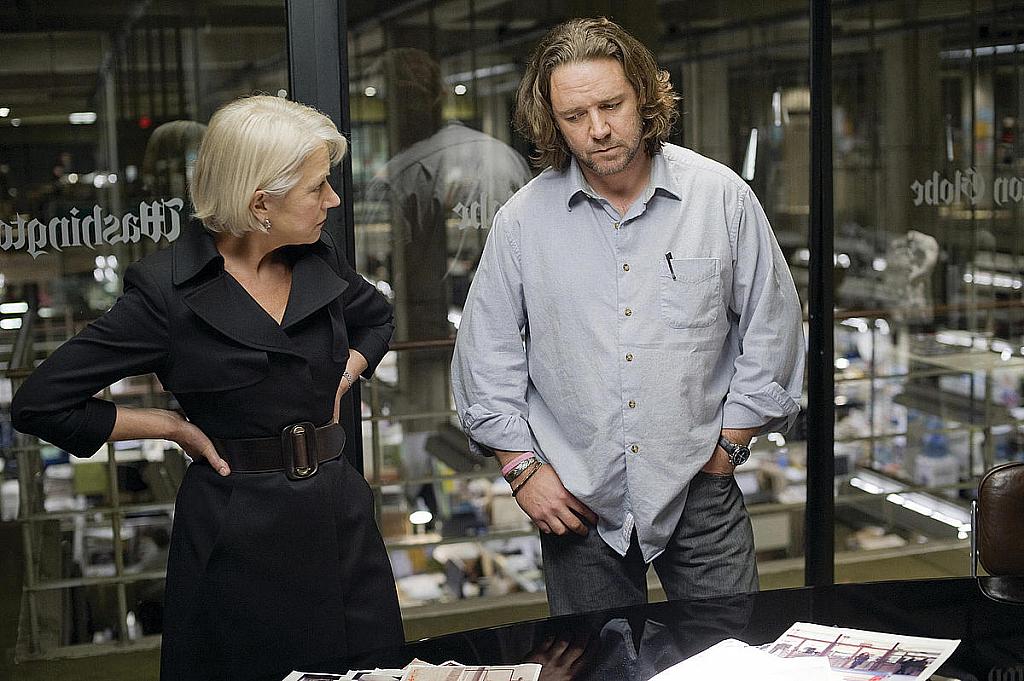
Helen Mirren maintains queenly control over her newsroom.

and we mustn’t forget the memorable performance by Jason Bateman as a wealthy pill popping bisexual public relations executive (Dominic Foy) who has information Cal McCaffrey really wants. Finally, who is it that plays the nut-job killer in this thriller? Michael Berresse handles that role and he’s just too creepy to talk about. Though I will mention this is the biggest role he ever landed. Good job, Michael.

Rachel McAdams is marvelous as Della Frye. 

There are other players, of course, who make this film work (the police, national media with some cameos, other politicians and minor bad guys) but they were so typical there’s no need to high-light them. What is truly an interesting thing in respect of this motion picture is the truth of what it could have been had certain people had their way. Russell Crowe was not the expected lead player. That was Brad Pitt. He signed on to the script in August, 2007 but dropped out of the production one week before filming was to begin. He didn’t approve of a re-write and wanted the film delayed until after a writer’s strike was settled and a compromise script could be created. No dice, the director said, and he instead spent his time going to Australia so he could talk Russell Crowe into acting the lead. There was nearly a scheduling conflict, since Crowe was then filming Nottingham (later released as Robin Hood), but the studios managed a schedule that allowed Crowe’s participation in both films. The biggest problem for State of Play was Russell’s need for exceptionally long hair. It was cut pretty short for his part in Nottingham and that required him to spend three hours a day in Hair and Make-up trying to create new  length for his mop (which explains his funky hair in this movie).

Messy Crowe looks like every report whoever interviewed me.

The Pitt fiasco set the film’s schedule back by one week. The original actor who signed on to play the slimy politician was Edward Norton ... the delay created a scheduling conflict for him and he had to leave State of Play under amicable conditions. His agent also represented Ben Affleck and the new east-er was quickly signed to play the roll of congressman Collins.  Affleck rushed  to Washington D.C. to prepare, meeting with Nancy Pelosi and other notable politicians. He said to perfect his character he drew on the experiences of Gary Condit, Elliot Spitzer, and John Edwards (I can see that in his performance ... especially John Edwards).

For certain, State of Play would have been a much different film had Brad Pitt and Edward Norton played the leads. I don’t think I would have watched it. As a general rule, I don’t care for political thrillers unless they are from a time long, long ago. (Like, how about something de’ Medici, Hollywood?) Most modern films stress too much about the ‘message’ ... rather ... spend too much energy tilting a story to promote their message and I think we get enough of that from every other turn. This film would have media bias, parallels regarding questionable home-land security deals (Blackwater?), corporate greed, calculated political coverups, etc. I could just watch some evening news or other television dribble for that. But, I like Russell Crowe enough and have come to learn that he has a wonderful sense about scripts and story lines, so I brought this one home. I figured Ben Affleck would suck ... but he didn’t. He is completely believable as a slimy up and coming politician.

I have to say, too, that the fellows who played the other politicians were marvelous. Many times I thought they were actual sitting elites who simply stopped in to give a sense of authenticity to the film ... especially the fellow who played Rep. George Fergus.

I know that politician on the left, I KNOW I do!

Another thing I truly enjoyed about his movie is the manner in which it was filmed. As it plays, you should notice that while you are in the reporter’s world, it feels grimy, dingy, the lighting is a bit harsher and often the rains are driving hard. While you are in the congressman’s world the space feels cleaner, depth of field has deeply shifted, and the crispness of a well ironed world is amazingly strong. It’s an attitude displayed visually. To pull this off, the director of photography shot media scenes in the anamorphic format on 35mm film, while the world of politics were shot in high-definition video using digital cameras. The effect is pretty cool and very cogent.

Jason Bateman's character is about to learn the will of the press. 

As the story goes, this is a high-paced thriller that holds attention well. There are so many twists, turns, and added information that it’s important you pay attention. It starts with a random and apparent drug dealer pop-off, then leads to a seemingly unrelated capital-hill-lower-level-employee suicide. As the reporting characters piece the puzzle, we are walked through the ethical struggles of old time investigative reporting versus modern shoot-from-the-hip blogging. I did enjoy the idea that the old-school would take the time to mentor the new school and the resulting product was good and honest. Too bad it’s make believe. The part that’s not make believe, and is shown honestly in this story, is the relationship between the media and politicians. It’s grittingly harsh to hear deals made and stories tilted according to the reporters whim. We all know it happens, and I think Crowe plays that angle of the tale really well – especially when he confronts Jason Bateman’s character. It makes sense that he would ... Crowe has a bunch of experience with real press. Regarding his attraction to this role, he explains:
"I wanted to explore the ambiguity of journalism... It's a kind of a conceit that journalists live under, that they remain objective. That's never been my experience. They're all too human, all too emotionally affected. Someone could write absolute rubbish about you because their aunty's having a problem with cancer or something. It's the way they re-balance themselves. So I think examining that conceit and examining the true input of human experience in the journalism that we read, it was very interesting for me." 
** quote from “Blazers Brush with Fame” by Anika Manzoor - Silver Chips Online
Even the reporter's apartment hints to the notion that a newsman's personal life may well affect his work.  Notice the campaign sign pinned to the bulletin board in the back.

Again, Russell Crowe carried a movie well, as I expected him to. Ben Affleck for the first time surprised me and I liked that. If you want to see a good movie centered around modern times and problems ... check this one out ... it really is worth your time.

Tuesday, September 7, 2010

Two for One - Part I

One of my least favorite actors is Ben Affleck. He is a thespian I would describe as one-dimensional and when I see him in a film I can never step out of the idea that I’m seeing Ben Affleck on the screen. He never convinces me that he is someone else for even a moment or two and I don’t like that.

Maybe he’s like John Wayne, in a sense, because it’s true I had the very same feelings about that American icon. It didn’t bother me with the cowboy, though – probably because Mr. Wayne always played the cowboy and what they called him in the script didn’t matter at all (Who remembers anyway? McClintock is the only character name that comes to my mind at the moment and I’ve seen every one of his westerns). And, I met John Wayne when I was young and he was exactly as I thought he would be. When he said to me in that very familiar drawl, “How ya doin’ little missy” I knew I was standing next to The Duke.

Maybe I’m more comfortable with the essence of a western cow-hand than the perceived snobbish ways of an east coast elitist? Even when Affleck played a non-elitist, as in his roles in Dazed & Confused or Good Will Hunting, he was not as grungy or natural as one would hope he’d be. Not even a little bit. I am wondering now, am I simply sensitive to the nuances that make up a regional personality? That possibility didn’t strike me until a week or so ago – after I watched a double feature with two fairly new Affleck movies.

First, I watched Hollywoodland (2006) and, yes, I’m the one who brought that home. I love subjects like the unexplained elements of an actor’s mysterious death, and anything showcasing the golden years of Hollywood will get my attention every time. The story of George Reeves, who was found dead in his home in 1959, definitely held a perfect MO for me. Sometimes I figure the story could be good enough to overlook what will probably be a weak performance and perhaps, if I’m lucky, this will be the breakthrough script for a stuck-in-a-rut actor.


It wasn’t. What charisma Mr. Reeves had did not shine through in Affleck's performance and I just didn’t believe him as the Adventures of Superman actor. If I were friend or family of the original star I do believe I would hate the film just because of the lack of personalty given to Reeves. Otherwise, though, the film wasn’t half bad. Historically it covered a lot of bases and does give the most notable possibilities regarding what happened the night of Reeves’ death. It lessened the evidence that points to murder, and amplified aspects that lean toward suicide and I found that a little unfortunate. There are missing clues that are worth researching after you watch the film, if you have a mind to dig a little further.

As for Affleck's performance, he did receive some pretty good reviews but I think most critics simply emphasized with Ben the actor.  Many of them draw a parallel between the two stars, who both struggled tirelessly to overcome the doldrums of a not so exciting acting career. With Reeves, he was a descent film actor stuck in a less than respectable TV star persona, and a relationship with a powerful and married woman. With Affleck he’s a descent looking guy stuck with the morphed nickname Bennifer simply because the world-wide-gossip-media found way too much interest in his relationship with Jennifer Lopez. In a strange sort of way, the two had something in common. At least according to a lot of critics.

A couple of inaccuracies within the film are worth shedding a little light upon. One, audience derision and heckling towards Reeves at a test screening for From Here to Eternity, which led to the consequent cutting of his scenes, is really nothing more than urban legend. No test screenings ever took place for that film and the finished movie includes all of Reeves’ scenes from the original script.

And two, on the night he died, all three scenarios imagined by a private detective showed George playing his guitar and singing ‘Aquellos Ojos Verdes’ in Spanish and off-key. George, as were all Hollywood contract players in that era, was well trained in singing and never would have been off-key; and Leonore Lemmon (George’s girlfriend and fiance at the time) said before she died in 1989, that George never came down from his bedroom that night at all. That scene did nothing more than make George look pitiful, which was far from what he actually was.

George Reeves and Leonore Lemmon
What was interesting to me was that a second-rate character (a down-and-out private-eye hired by George’s mother after his death was ruled suicide) became the most interesting personality of the film. That should never happen in a bio-pic, but it certainly saved this film from complete disaster. Adrien Brody cleverly played a believable investigator who was interested in making a fast buck while, perhaps, even making a name for himself. By the end of the film he became not only sensitive to the personal tragedy surrounding George Reeves, but his own self-evaluation brought a certain conclusion to his own personal family disaster. I felt more sorry for him than for George ... which was weird, except when I realized that the suicide of Superman was actually traumatic for middle class America, I found it made a bit of sense. If a speeding bullet can bring the hero down, then what is left for the rest of us?


Meanwhile, Diane Lane (who played Toni Mannix, George’s married mistress) nearly stole the show with her predatory way, speaking with a hauntingly forced yet not over played Hollywood accent, and gracefully expressed herself with a refined and manicured demeanor. The essence of movie making in the 1950s was quite strong and I enjoyed the sets, props, clothing, and stylish film-making. Visually, it is a wonderful film to experience.


So, here I am recommending a Ben Affleck movie, not because of his performance at all, but because other players did a marvelous job stealing the show from the star. More than that, George Reeves is one we should learn a little more about. He is another of those Hollywood tragedies that seems to be buried back there, somewhere, and it feels to me that he’s never really been given a fair shake.

In the coming second half of this two for one, I’ll explore the east-coat elite side of Affleck by comparing him with none other than Russell Crowe.

Monday, August 2, 2010

Changing Your Stars


Chelsea Clinton got married yesterday. Lindsey Lohan sat in jail. Mel Gibson’s chaos has quieted down a bit. Michael Jackson conquers death with a new album due out in October. And, I’m wondering what to write about today.

I look around and I’m just not inspired with the cultural side of life these days. I’m apparently going to continue to sound like a broken record, pining for the good ol’ days when culture and class ruled everything. I am pondering this because I ran into a  dilemma this week in respect to what would be a good and appropriate movie for my six and half year old grandson to watch with me. The choices are tough, I think.

Foremost, I am boycotting animation. I’m sick of ‘em. I want to see real people performing amazing scenes. I want to believe in the magic of the human spirit again. I want my grandson to experience that, too. For him, at his father’s he’s been fed animation and superhero crap all his life; bombarded with flashing weapons, sped-demon vehicles, and monsters made from machines or hatched from a fiery dragon’s lair. In the old days our heroes were cowboys, astronauts, explorers, muskateers, firemen, and cops. I often recall what my daughter tells her son again and again, “No matter how many times you dress up like Spidy, you are never going to stick to the wall.” Doesn’t that just say it all?

When I first approached my daughter with my dilemma I was taken aback by the movie she suggested. I love the film and think it’s one of the most cleverly written adventures around, yet I thought it might be a bit too rough and mature for a little one. She reminded me of the movies and ‘toons the boy sees at his dad’s. Considering that, I suddenly found myself wondering if he would be too bored to really get the point of this tale. That wouldn’t be good, for the point of the story is truly the treasure of it. We grabbed the reins and charged ahead with pizza and rootbeer floats, ready for our movie night. I showed my grandson the DVD box and waited for whatever reaction he might have.

The tag-line of the movie certainly helped the little one’s interest:
“From peasant to knight; one man can change his stars”. Thanks to the Backyardagains he knew what a knight was, but he had to ask what it means to change the stars. What a wonderful opportunity to begin to help him understand the beauty of hopes and desires, and how we have the will to charge towards them and make our life whatever we want it to be. I quickly gave him a snippet of the story thread ... a poor boy (William) is given to a rich man, to be his servant, and he will travel the world and learn as he works as a valet. His father sacrificed by giving his only son, offering him hope and possibly a better future. As the boy got ready to leave, his father encouraged him, “Change your stars and live a better life than I have.” William sadly said,  “Father, I am afraid, I won't know the way back home.”  Father replied, “Don't be foolish, William, you just follow your feet.” Then the story really begins.


That is all I told my grandson about the movie we were ready to watch. As he walked across the living room to sit next to his mom the soundtrack and menu screen began playing. Rock music pounded, knights in shinning armor charged along the rail and rammed lances into the chest and heads of opponents, unseating them. In slow motion the lance tips exploded into splinters while the riders careened and fell. Some hit the ground. Some lay back on the horses’ rump. Another slid along the rail. My grandson stopped in his tracks and simply stared in awe at the looping promotional opening. He did not move until we stopped the menu. Once he found his seat he breathed a reaction, “This is going to be so cool.”  I thought to myself “That answers that ... this movie has his attention, now can it capture his heart?”

The production I am talking about is, of course, A Knights Tale. I’m not going to spend my time going through the plot or providing a synopsis, and there’ll be some spoilers in here, too. I figure most have seen this flick and, if you haven’t, what’s wrong with you? It’s got great costumes, adventure, heroes, a bad guy, a princess, and head-banging music to boot! Sure, there are TONS of continuity issues ... like the scene where Geoff has some cloth stuffed up his left nostril to stop a nose bleed, then it switches to the right side in the next shot, then back to the left. Or, during that last joust the horse’s armor switches from old leather in a close up to the new metal one in the next take. There are so many continuity errors that you could make a drinking game of it, which is why it all seems in spirit with the movie’s intent anyway, so who cares? This movie is just plain ol’ fun to watch.


What makes it an interesting choice to share with a little one was my daughter’s reasoning for allowing it. My first instinct was to say, “No way!” simply because it carries a PG-13 rating. But then, movies from even a few years ago where rated by stricter measure than they are today. I understand that. I’ve seen recent made-for-kids-movies in animation that utterly shocked me when considering content and choice of words, so what do I know about ratings? My daughter put it plainly: A Knight's Tale is all about not having to worry about sticking to a wall. It has a hero that is working to better himself, and he is just a human. He doesn’t need a special suit to be exceptional (although, his new fancy armor might actually qualify!) This hero (who is William) decides what he will do to change his stars, then practices for perfection and competes in sporting events to better his standing and financial condition. He doesn’t just take it, he earns it. Along the way he consistently shares with his friends. Sure, the script has the ‘s’ word in it (that’s ‘s’ for Shite, which is cute, if you ask me) and a couple for God’s sakes - I think there is a BS, too. All in all, it really is tame in the language department.

The bad guy (Adhemar) isn’t really that bad when compared to the bad guys that my grandson sees at his dad’s in other sci-fi adventures. He is a jerk, yes. And, he cheats to win. He’s an elite snob. But he doesn’t try to rule the universe and he wasn’t enhanced by any super power what so ever. More importantly, he doesn’t kill. In one scene where he ‘tips’ his lance with a hidden sharp point, and that point drives through William’s old armor at the shoulder joint, and the armor is removed after the run, there is only a small amount of blood and it’s obvious no life threatening event took place (another continuity error in this scene - when first shown, the padding under the armor has a hole with blood around it, moments later the hole is gone and only a little blood remains).

We do see a naked man’s butt from behind and from the side, but it’s done in a way that’s not shocking and no frontal nudity shows at all. The character reinforces well the idea that people should not be naked in proper society, and teaches the lesson that gambling is bad for a guy. One can, quite literally, lose the clothes right off your back. My grandson vocalized the moral lesson learned right after the gambling in town scene. I was impressed at how well he understood the concept, relating how unfair it was for the gambling friend to expect someone else to pay his way. As the boy said .... that’s just not right. The character learned and behaved quite admirably the rest of the movie and my grandson noticed that.

Of course, how could I mention this movie and not talk about the music? That part of this creation, I think, was brilliant and I knew it would give my grandson the emotion of the story, especially if he couldn’t understand all the words that were being said ... which many times was the case for him. Take, for example, the thread that asked early in the film, “What do you mean, dead?” The reply simply stated, “The spark of his life is smothered in shite. His spirit is gone but his stench remains. Does that answer your question?” Combine those clever words with a strong English accent and you have gibberish a child will not understand. My grandson asked me, “So, is he dead?” To which I replied, “Yes.” Early in the film we had to clarify what was happening.  Soon, though, the intent and story shone through well enough for the boy to understand what was happening.

I imagined this movie would do for my grandson what Romeo and Juliet did for me as a kid (That movie also showed a butt, by the way, go figure). If the story was filmed perfectly, and the actors played their parts naturally well, then a good understanding of the tale will come, even when verbal comprehension is lacking. That did happen with Romeo and Juliet for me, and it happened for my grandson in A Knight’s Tale.

The music in the film gave everything to the emotion of the players. Watching fans in stands at a jousting match as they clapped and chanted along with Queen, singing  We Will Rock You loudly; or seeing William and the Princess dance to David Bowie’s Golden Years was rather funny, considering the costumes and such, yet it definitely enforced the attitude of the people in their time. We related to the emotion immediately and it didn’t feel weird at all. Just ... funny ... and entertaining. Brilliant. If they would have played a renaissance ditty my brain would not have gone to the energy driving rhythm that fans produce at sporting events. It was important we felt like we were working our way to the superbowl of the day and this film did that better than ever.


In the end, my grandson said that was the best movie ever. It’s his new favorite and he’s said a couple of times since that he is going to change his stars. He may not totally understand what he is saying, but he’s got the idea that he can control his life. I think of the line William’s friend said to him when he first heard the plan for future glory, “We're the sons of peasants. Glory, and riches, and stars are beyond our grasps. But a full stomach, that dream can come true.” We will never better ourselves with that attitude, and I think my grandson understands that on his elementary level. My tough job now is to find more entertaining movies to watch with him that will reinforce it.

** Don’t forget to fast forward through the credits at the end. There is a fart joke that really captured the little one’s funny bones ... we had to watch that little snippet 4 times.

Saturday, July 17, 2010

Ghosts of Artist Past

Sometimes I read movie reviews and wonder how a person gets a job like that. How can they be paid to put words to paper that bash creative ones, or pump-up others to an insane degree? More importantly, why is it that a movie’s success depends on the critics at all? Couldn’t a great movie withstand the hoopla of critic bashing and still perform well? Unfortunately, most of the time they don’t, especially if that movie was not produced in Hollywood. I’m going to introduce to you what I think is a great movie that critics have soundly trashed. There will be some spoilers in here, but knowing parts of the story will not ruin the movie for you. This film is fiction based on truth and I think the human behavior aspect of it is simply priceless.

Goya’s Ghosts (2006) has several elements that made it attractive for me.  First positive element: It is a story told from an artist’s point of view and that’s a natural interest for a mind like mine. I love art … particularly art history.  Granted, Goya is not one of my favorites – I find most of his work repulsive and dark. But, why wouldn’t it be? He lived through the Spanish Inquisition and saw things few humans could stomach, so of course his paintings colourfully depict brutality and nightmarish visions.

Francisco Goya is fascinating in the sense that he is regarded as both the last of the Old Masters and the first of the moderns. He was a painter of royalty on the one hand, and a macabre printmaker on the other, whose prints created images depicting, what he called, “...the innumerable foibles and follies to be found in any civilized society, and from the common prejudices and deceitful practices which custom, ignorance, or self-interest have made usual.”  They were very dark visions.

The movie does a fabulous job showing the artist working at his craft ... it is played so naturally that you don’t realize what you are seeing. Printmaking, for example, is shown step by step with process explained through doing. The same holds true for oil painting and sketching. As an artist, I appreciate a certain ‘realness’ when art production is shown and I like to understand how things are made. Goya would have painted just as it was played for the movie – it’s a very traditional process that has nothing to do with the modern directive of inner visions or personal emotions. It is always delightful to watch an artist properly work in the context of actual historic processes.

Second positive element: The movie was directed by Milos Forman. A few of my all time favorites where directed by this man and his sense of visual interests and story-thread certainly appeal to me … One Flew Over the Cuckoos Nest. The People vs. Larry Flynt (a surprisingly good movie). Man in the Moon. Amadeus … Every one of these is a psychological study of human condition and reaction. I did not doubt that Goya’s Ghosts would deliver in that respect as well.

After a few Milos Forman movies I found myself wondering what it was that drove him to concentrate so intently on the psyche of an individual human mind under stressful conditions, and how it relates to others’ minds as they weave and interact through life. Most notable in his history is the truth that his parents died in a concentration camp under Hitler’s regime. Could that be his driving force? Perhaps. Certainly, I’ve never seen another who could so effectively develop a stressed character like Milos can – a character that is intensely portrayed by the subtlest of gestures, the nuances of body language, the inflection of vocal tone. I do not understand how he draws this quality from actors, he just certainly and consistently does it.

Third positive element: The movie was produced and filmed in Spain, not a Hollywood production. Hollywood can tire me sometimes, with their fast paced and visually intense productions – especially with epic historical dramas. I do enjoy costumes and panoramic sets, though sometimes those can overwhelm the story. This tale was about an era that was grungy, harsh, yet beautiful. Having Spaniards tell  me about it would add a bit of authenticity, and I liked the thought of that. It could feel grand without trying so hard and every detail in the backdrop could be just right. I was eager to experience Spain.

Forth positive element: Critics absolutely hated it.  I think it is one of the most dissed films I’ve ever read about in reviews (right up there with Amelia). None complained about the acting, nor the costumes and sets, in fact they liked that stuff. They just expected more and complained that it was undercooked. I don’t know what that means.

Here’s the truth about this film. It’s more accurate, historically, than most any film out there. There were only two glaring errors that I could see: One, the film begins in 1792 with the inquisition examining the “Los Caprichos” etchings. Goya did not create those until 1797. Two, when Goya unveiled the unflattering portrait of Queen Maria Louisa she was deeply offended and huffed out of the room. In reality, she loved the painting so much that she promoted Goya to first court painter. Both of those twists on reality where done to direct the story certain ways and I got through them without complaint. This story wasn’t a biography of Goya’s life and career. It was a study in human behavior and it involves three characters that are figuring out how to survive a time of extreme chaos and turmoil.

Visually, everything worked. Natalie Portman was cast as Ines after Milos Forman recognized her likeness to the girl in Goya’s painting “Milkmaid of Bordeaux”. She played a wealthy merchant’s teenage daughter whose portrait was painted by Goya, and who also sat for him as a model for angels in public murals and such. Portman does her part so well one could say she actually plays three roles in the film … pre-Inquisition Ines, post-Inquisition Ines, as well as her grown daughter, Alicia. There is a certain madness that Milos seems to appreciate and showcase, and Portman naturally provides that element to the film. She does hold a bachelor’s degree in psychology (Harvard) so I suppose her mental probing of the character would be the expected thing for her to do. She does seem to delight in the insanity of it all. There are times when you watch and think, man, the girl is completely mad and moments later she comes across sharp and clear, very aware of what is happening in her world. She sort of fades in and out of reality as the story moves along, in a not so obvious way. It’s brilliantly played and rather charming, in a weird kind of way. I ended the film feeling empathetic for the Ines, and loving her for all her madness. It’s funny … I reflected Goya in respect to the girl and found myself thinking about her for days after I watched the movie.

As for Goya, Stellan Skarsgrd looks very much like the painter. What I enjoyed about him was the complete normalcy of the man, both in appearance and in action. He was simply a painter who networked and searched for whatever commissions he could find. He was not a handsome and dashing Spaniard (as Hollywood probably would have cast him), just an average looking fellow who finagled himself through the chaos. He was portrayed as decency incarnated, which is everything I imagined Goya to be.

The third arm of the triad of characters is Lorenzo, played by Javir Baldem. Lorenzo is a person that is easily hard to take, yet as his character developed I began to understand his motives, and I did wrap myself around his persona before the movie was through. I liked Baldem in this role … a lot. He has a nice perspective on his job as an actor, once saying, “I truly believe that what I would like to portray on-screen are human beings, and human beings usually are not as handsome as movie stars.” Again, it’s all about personality studies and this movie was perfectly cast. Just watch the transformation of Lorenzo, from the opening scene to the last ... it is an astonishing journey of a man searching for conscience of faith.

The historical setting for this movie is huge. We experience the rebirth of the Spanish Inquisition, then turmoil at the end of Catholic rule as Napolian’s army invades and conquers Spain, and finally England barrels in and frees the Spanish from French occupation, and the liberated ones bring back Catholic rule in the end. What a waste through war, is what we see, and all things that turn around come around again. Goya’s etchings, which are shown throughout the movie, reflect things he witnessed – both the brutality of war and life in 18th century Spain. What Goya drew and painted is shown on film and whether you realize it or not, his eyes directed Forman in respect to set, just as Forman’s mind directed the psychology of it all. And, throughout that process, the three primary characters are continually finding each other’s orbit as we walk through this truly disturbing part of history.


I wonder what critics are thinking sometimes. Are they more concerned about a movie being enlightening, or cutting-edge, or faster or brighter or louder or more animated than the last one, or … what? What does under-cooked mean, anyway? The movie is almost there? It’s not well exicuted? One theme I caught through all the reviews I read was that every one of them missed the entire point of the film.  This is NOT about Goya or his muse. The title even states that clearly. It’s about ghosts. Not Goya’s ghost.  Goya’s ghosts ... more than one haunting person that belonged to the man. It’s not a history lesson about the ups and downs of the Spanish Inquisition, either, or foriegn occupation or political upheaval at all. A ghost is not events or time or space or subject matter. It’s a haunting person. More than one is haunting people. … and haunting generally indicates a troubled soul ... unable to rest.

When watching a movie like this, which is really a movie about pshychological evaluation/penetration, I find myelf examining things like being ‘put to the question’. What would I do should that have been me? Whould I say I love pork after all, or that my mother was a monkey? Or would I hold faith so dear that I’d suffer the pain? I must ponder piety, morality, civic duty, and basic survival to find that answer. And even then, I know I would have to live it … to feel the pain for the truth of it all is more than I can imagine.

Grasping this concept is not hard. Goya was an artist who chronicled a time. His paintings and drawings share with us what touched his heart through eyes that saw things few ever see. His ghosts are with us today – on his canvases.  He gave us souls who struggled and suffered and most did not survive. His people. His country. Ines could easily represent his homeland as a victim who never gave up. Lorenzo would be the heart of the country that forever searched for conscience. And Goya is the steady and decent soul.

You must look at this movie from an artist's eye and it will make more sense than any critic can imagine.

Tuesday, June 15, 2010

Extraordinarily Ordinary - What Do Dreams Know of Boundaries?


A new movie about Amelia was released in October, 2009. I, of course, waited patiently for the film to be released on DVD so I could bring it home and enjoy it at my pace, with my own really cheap and lightly buttered popcorn. I had a hunch I was going to like this movie simply because the reviews that followed it’s opening gave insight regarding style and content that actually sounded great to me. I’m going to spend a moment or so with critics’ words, if I may, and defend a movie that has been brutally bashed since it opened. 


 Frustratingly old-school; Hollywood-style Entertainment Weekly:
Ok, I understand that today many people like fast-action-jerky film work, or weird experimentations from the ‘sundance’ crowd. Truth is, some of us completely enjoy still-camera cinematography; we like to build a story visually, piecing things like costumes, sets, and audio tracks together with a steady, and I mean steady, accumulation of information. Perhaps that is old school, but I’m old so who cares. I like it. In Amelia, it’s one of the most charming aspects of the film. I can watch it and not become nauseated, which is amazing because I hate to fly and there are a lot of shots that are way up there looking down.


• The movie is imprisoned in safety NPR:
The movie stays right on the truth the entire film. It ignores urban legends and myths and, instead, concentrates on a nine year span of Amelia’s life which is mostly shown as her personal reflection of events that brought her to that fateful flight in 1937. She is winging around the world while she remembers. What else would the woman have done? If I were in her shoes I would have been full of retrospect, and this point-of-view has to limit the story to an absolute and safe place. Amelia’s diaries and log-books were heavily quoted and the voice of the aviator comes across clearly, even ordinarily quaint some times.


• The script smoothes over the many controversies surrounding her life, including her open marriage to Putnam, her rumored bisexuality, and whether or not she was a spy. Jezebel
Oh, my ... um ... let’s start with the open marriage. Yes, Amelia and George had an open marriage, which was more than unusual during their day. The proof of that is the letter she wrote to Putnam when she finally accepted his sixth marriage proposal.

"You must know again my reluctance to marry, my feeling that I shatter thereby chances in work which means so much to me. . . .In our life together I shall not hold you to any medieval code of faithfulness to me, nor shall I consider myself bound to you similarly . . . .I may have to keep some place where I can go to be myself now and then, for I cannot guarantee to endure at all the confinements of even an attractive cage."

The movie showed her writing that letter and giving it to her husband to be, and the idea of an open marriage was covered pretty well in this script. The only things missing were wild sex shots and in your face social judgments and lecturing. Frankly, I don’t want to imagine Amelia doing that and, in my opinion, she never did. Listen closely to her letter and you may hear a gal who was concerned about being owned. Remember the year (1931); understand what was expected of women back then. Amelia was fiercely independent and wanted to remain that way. She wanted to fly.

As for bisexuality and being a spy? That is pure speculation not founded on any provable truth. For folks who want to see this sort of story, you ought to write a script and call it Stella ... base the story-line on Amelia but add your fantasies for fun. You could have your steamy Ewan McGregor sex-shots, sultry leads, wild explosions ... CGI the plane ripping apart as it bounces across the ocean, what the hell. Stella could parachute out in time (not the navigator, though ... a man would not think quickly enough) and land on an itty-bitty South Pacific island, be a castaway for a while surviving by her own American-heartland-wisdom, drinking cocoanut milk and eating killer crabs she wrestled with her bare hands before the Japanese found, imprisoned, then lastly shot her dead-by-firing-squad for being a spy.  Dammit! That is filmmaking -101 ...

But that’s a different story ... let’s get back to
Amelia and the critics.


I'm not suggesting that Mira Nair should have invented anything for Amelia. It is right that she resisted any temptation. It's just that there's a certain lack of drama in a generally happy life. Chicago Sun Times:
This movie is not about Amelia’s life. It’s about a nine year span that lead from the first woman to sit on a plane flying across the Atlantic to a woman who was piloting a plane while trying to circumnavigate the globe.  Yeeesh ....

There are aspects about Amelia’s early life that are very interesting to ponder, and they follow a trend most surely. For example, Amelia did not grow up in a normal home with mother and father. She was sent to live with her grandmother, then on to finishing school. Dad was an alcoholic and that unsettled Amelia’s world on many levels. The same kind of thing was true for the other strong ladies I wrote about earlier in
There’s No Crying in Baseball. Dottie (Dorothy Kamenshek) went off to play baseball at 17 years old. I can’t find any information about her childhood or family relations, but how many 17 year old girls would have been allowed to go alone to Wriggley’s Field to play baseball during WWII? And then there’s Donna Hillman-Walsh, who grew-up the daughter of a Hollywood starlet and was sent away to finishing school at 14, then headed out to New York to learn how to race thoroughbreds. Research either of these ladies and you’ll find very little information about early family life and relationships. Truth be told, all these girls were extremely independent tomboys who’s goal in life was to be the very best that they could be, doing what only men were allowed to do. All were highly motivated, and all were very good. I would be interested in watching a film or documentary about this sort of stuff. But not in a film about a nine year span that lead to Amelia’s final flight. For now, let us focus on this movie and understand that Amelia was generally happy to be flying. Ok. What’s wrong with that?

•  Amelia is a by-the-book bio-pic. By following the template, it's as safe and straightforward as one could possibly get, without narrative flourishes and with minimal exaggeration to satisfy Hollywood's appetite for fictionalization. Reel Views

YEAH!!

•  When it comes to some of the wild speculation that has arisen over the years about what happened to Earhart during that final flight, the movie doesn't even go out on a limb, opting instead for the sort of vague, open ending that, is historically safe and cinematically dull. The Washington Post:
It is true, this movie does not dare to try to answer what happened at the end. Amelia simply flies away. This movie is true on fact and as such, how could it speculate an ending?


•  ... old-fashioned, star-powered bio-mush Variety:

•  ... an object lesson in the follies of the conventional biopic, which puts mindless recapitulation of historical data above analysis or insight.  A.V. Club:
Did this critic just say that opinion should rise above historical data? I say, save the imagination for fantasy scripts. A film like Amelia should be held to standards of accuracy just in case some young person who knows nothing about Amelia sees it! Entertainment can teach and there’s nothing wrong with that. In fact, wouldn't we be prudent if more films aimed to educate?

I could go on and on with these reviews, but you get the point. How about we simply consider the film without the disappointed critics’ ramblings about what they wish it had been. True, anyone who ever researched Amelia knows the story going in, and comes away with no new information. The tale is what it is, why expect more? If you can’t handle that sort of thing don’t bother watching this movie. You would miss a beautiful film if you opted out, though, and just seeing the old-time news reels morph into modern day, full colour actors is a truly sweet effect.


Hilary Swank does a marvelous job becoming Amelia, though at times I could swear I heard Katherine Hepburn dialoging in aviator costume. As a girl I had a vision in my head that was Amelia and Swank nailed it for me; her big goofy grin, the confident swagger, the midwestern speech-halting accent, the kind of shy yet public figure, the in-love with her man though not publicly showing it woman.

In truth, there was only one person cast in this film that I wish had been just about anyone else. Whenever I see Richard Gere (he plays Putnam) in a film I see only Richard Gere, never the character he’s trying to play. The sets, costume, and filming technique all took me back to another time and I loved that. Richard Gere would rip me right back to my time and I hated that. George Putnam was a ground breaking fellow who, with Amelia, presented the very first public relation/image building situation and made her a star. He had a certain charisma and style. Richard Gere is frumpy (I thought so back when I first saw him in American Gigolo, I’m just sayin’). And, not even considering his acting, the guy is just too old for this one and does not look good in 1930s costume. Still, even with that, I like this film very much and would recommend it to anyone who wants to know about, or simply remember, Amelia.

As for her fate and the open-ended conclusion of the film, I think it’s our job to research and dig and learn. For sure, the truth is not settled yet, though many people think they know what happened. Some still cling to spy notion, others to the drowning theory, and some (like me) are convinced that Nikumaroro (Gardner Island) will prove once and for all that Amelia Earhart was a damn good pilot who didn’t survive because the United States Navy failed her.

Consider all the evidence I mentioned in part one of this story, and add to them this:

• Amelia’s last radio contacts where strong and clear, which indicated she was very near Howland Island and had the seaman on duty the night before not left certain tracking equipment powered on, the battery would not have been dead and the Navy could have pinpointed exactly where she was during every last moment of her flight. (yes, this is shown in the movie)

• Amelia’s very last transmission said   "We are on the line of position 157 337. Will repeat this message on 6210. We are running North and South." That put the Electra on a navigational line that coincides with the Phoenix Islands, with Nikumaroro (Gardner Island) specifically. The plane had more than enough fuel to get there, and the tide was low and the island’s reef was dry during the time they would have arrived, and that island is much easier to see from air than Howland. The reef is big and smooth enough in places to permit a bumpy, yet safe landing. As far as Amelia knew, the navy could track her. Landing was a smart thing to do.

• Credible radio distress calls were heard over the next four nights. Those transmissions coincided with times when the tides were low enough to allow prop clearance for an Electra’s engine to run. Why is that significant? The engines running at a certain speed would charge the batteries needed to send out signals. And, if the plane ditched into the ocean no signals could ever have been sent. All electrical systems would have failed if the plane did not sit on land, with undamaged landing gear beneath her.

Directional bearings of nearly 200 distress calls, taken by Pan American and the US Coast Guard, pinpointed those distress signals in the vicinity of Nikumaroro (Gardner Island).

• US Navy search planes did not fly over that island until a week after the plane disappeared. By then, distress signals had stopped. The pilots of the search planes noted “signs of recent habitation” on this officially uninhabited island. They saw no aircraft, but a photo of the island taken during the search shows the tide was very high with rough surf on the edge of the reef. If there were an aircraft on that reef, it would have been hidden by the surf.

• A colony was established on Nikumaroro (Gardner Island) in December, 1939 and residents from there report that aircraft wreckage was on the reef, as well as in the lagoon, when they came. They, apparently, stripped many parts from the crash and used them to fabricate things for themselves. A US Navy pilot saw island locals using an airplane control cable as lead fishing line. He asked them where they got the cable, they said from the plane wreckage that was there when they arrived.

One part of the Amelia story that truly annoys me are the words repeated by the fellows who let the lady down. They were very quick to point fingers at her, claiming she was a terrible pilot without the skills needed to complete her mission. Truth is, some fellows simply could not take orders from a girl, nor would they ever accept that a female out-performed them. Amelia was an amazing pilot during the time when aviation was new and extremely dangerous. She did things men died trying to do, and I believe she landed that plane on a small island out in the middle of nowhere, and the Navy did not heed reports of distress signals or take the Gardner Island theory serious in the days following her disappearance. She is my hero, as most strong and independent women are, and I am grateful for sky trails she blazed all those years ago. I encourage you to watch Amelia with those sort of thoughts in mind. 


And we'll leave this post with her words ...


"[Women] must pay for everything .... They do get more glory than men for comparable feats. But, also, women get more notoriety when they crash."


Monday, May 31, 2010

And We Throw the Remote Because ....

When was the last time you watched one of those movies that just pissed you off? Not pissed because of content or storyline, just pissed because you felt you’ve been duped and wasted nearly two hours of off-time. And, what’s worse about the pissy movie is the truth that the previews didn’t look all that bad and you know it could have been lightly entertaining, or at least mildly cute. Expectations weren’t that high anyway, simply because it was just a silly romance/comedy. How hard could it be to make one of those that is palatable? Notting Hill did it. 50 First Dates did it. Two Weeks Notice pulled it off. The Princess Bride felt like a classic while doing it. My Big Fat Greek Wedding was exceptional at it. Even in Splash it was ok to watch a fella fall for a fish. But this thing I saw last night ... oh ... my .... gosh!

What in the world is up with Sarah Jessica Parker? 

I confess I had never seen her in anything before and couldn’t pick her out in a crowd of ten. I heard she was in something rather popular called Sex in the City. I think that was a television show, but I don’t watch TV so I wouldn’t know about that. They might have even made a movie or two out of it. I just don’t positively know. However it comes, I’m not one who will give time to something called Sex in the City. If sex is different in the city, I don’t want to know about it. If it’s not different in the city, what’s the point of putting it to film? I admit, here and now, I could be very wrong with this opinion. I only know I stopped watching TV by choice for a specific reason a long time ago. I will probably dig into that subject one day, but today, I’m rather inclined to talk about the movie that pissed me off. 

The thing that can make a movie work, even if the writing is ordinary, or the sets are cheesey, or the director is clumsy ... is the cast. If chemistry between people can be found then things like American Pie can have success. If chemistry falters, then colossal failure can make the best of scripts go bad. 

This movie had Hugh Grant as comedy/romantic lead. He’s a given okee-dokee for this sort of role. Easy as pie, he can pull it off. Sam Elliot played a ranch hand and State Marshall. He rode horses, shot a gun, and tossed horse-shoe-ringers like batting a bug. Wow! That’s another easy as pie. Two for two. Mary Steenburgen played the roll of Elliot’s wife and she looked just like a ranch-hand lady I know, even talked just like her (Hi, Teresa) ... pulled it off.  Easy as pie. But the female lead ... Parker.  She parked the film dead in it’s tracks.

Why so harsh, you ask? Have you seen her try to act? Have you heard her voice drone on and on ... apparently never shutting up while her hands constantly touch her hair? For the first time ever my family and I hit mute when her speaking parts came, and would only resume volume once we saw her co-star’s eyes glazing over and the camera switching to the next scene. What is strange about that is none of us felt like we missed any of the story. Add to it, I’ve seen Hugh Grant in many films and, sure, he’s a stiff English guy that always looks uncomfortable around girls, but there’s a consistent sense of likability between characters. Not in this film. Grant and Parker have all the chemistry of pint-sized mosquito and a horny-toad. It was really painful to watch and I don’t hold that against Hugh Grant. 

So, I’ve had a day to simmer with this stupid movie. That’s probably why I’m pissed because, now, it’s taken far more than the nearly two hours I spent with it last evening. I’m trying to understand why I had such a bad reaction to this actress. How could the first ten minutes of the film tempt me to throw the remote at the TV and run away screaming? And why didn’t we just turn it off once we saw what it was?

I know, for me, it’s the ying/yang thing.  You can’t see the light without the dark.  You can’t have an up without a down.  You can’t miss what is gone if you don’t see the now.  Parker is the now.

What is gone? Beautiful, classy, mannered, respectful, magic, intelligent, stimulating, mysterious, well dressed, healthy.

What is now? Painfully fake, rude, ugly, disrespectful, predictable, ordinary, boring, self-centered, frumpy, judgmental.

What is gone? Marilyn Monroe, Katherine Hepburn, Maureen O’Hara, Vivien Leigh, Natalie Wood, Raquel Welch, Joan Crawford.

What is now?  Sarah Jessica Parker, Paris Hilton, Jennifer Aniston, Angelia Jolie, Pamela Anderson, Sharon Stone, Lindsay Lohan.

Take a moment to think about that.

You know, it never really mattered how physically pretty an actress was back in the day. She always looked good – just by the clothing, hair and, most importantly, the manner in which she carried herself. The same was true for the men. I miss that ... The biggest rebels of them all (like Francis Farmer, for instance) bucked the system a bit and didn’t play the game by letting Hollywood choose their name or who they’d marry for public relations. But they always looked good (In Francis’s case, at least until they put her in an asylum and hid her away ... but that’s another story). From the point of view of the kid who sat at the theater munching popcorn, those people who acted were simply amazing and perfect humans. Today I often want to throw the remote at them. 

It shouldn’t really matter how Hollywood presents it’s players, but it does. Young people imitate what they admire and Hollywood heroes influence far more than we give them credit for. It goes deeper than that, though ... deeper than the superficial “this is how I’m going to dress and wear my hair and talk” imitation sort of thing. I’m thinking of simple behavior. 

I’m not sure when that element of our society changed, exactly, though I suspect it had something to do with curtailing descipline (I don’t count time-outs as discipline), the halting of teaching of etiquette (yes, I walked around with a book on my head and learned to eat soup without slurpping), and twisting a truly defined sense of masculine/feminine (don’t read into this one, I’ve always supported equality and women’s rights - I’m talking about simple balance here, like nature balances). 

That’s brought us to a place where, I don’t know about you but, I’ve come to detest going where little kids may be simply because it’s difficult to tolerate the screaming, running, whining, demanding little people. I watch many young mothers and it’s pretty easy to see that they don’t know how to parent, they have no control, the kids control them. The sad part is that the children are not bad, and neither are the young mothers, they just don’t know any better. There’s a generation that dropped the parenting-ball somehow and those resulting lost young ones are going to have to figure things out on their own. In the mean time, all the Hollywood hoopla pushes the condition by using toys, clothing, foods, and whatever else they can, as vessels to slap the latest-greatest movie character onto. It is their intention to drive the demanding kids to beg the young parents to buy, buy, buy. It’s working. And it’s killing our society. It’s killing it faster than Joe Camel could have ever dreamed.

In my ponderings you are going to find me talking about movies that have survived their opening season and are now only available on DVD (except for special occassions when I may go to the theater).  I’m inviting all who will listen to try this approach with me. Stop playing Hollywood’s hoopla game and spend some time at home, with your family, watching thought provoking productions. Skip the commercials and sales pitches, fast forward through previews that scream and flash and push mediocracy. Consider the players; learn who’s writing, directing, making costumes and sets. Verify movies based on truths and find yourselves talking about life and people. (It's like reading a good book together if you play it right) It doesn't matter how much money is spent on a film (Good Will Hunting), it doesn’t even matter if the star is well-known. What really matters is quality. So much of the time it’s about money, it seems, and who pulls in the most on opening week. Forget about that and let’s enjoy things that have stood the test of time, either short term or long. Let’s reward creativity of the mind, not of the marketing.  ‘Cause, dang it!  Sarah Jessica Parker is a terrible actress ...

And Sarah Jessica Parker makes me think of these things.  Damn.

** The movie is called Did You Heard About the Morgans?  I recommend you avoid this one ... **
  

Thursday, May 27, 2010

It’s Time for Your Close-up

I sat in the dentist’s chair this morning waiting for my turn with the tooth man, when the assistant asked if I’d like a magazine to read.

“No, thanks.”  I said.  “I’ve read all in the rack.”

The selections were rags about Outdoor Camping (as opposed to what? Indoor?) and How Things Work. Pretty simulating reads for a dentist’s visit and interesting enough three months ago. She said she had a new magazine in her car and proceeded to fetch it for me. It was People. Sorry, but I think that is some of the most boring dribble out there and I’m too old to begin to appreciate the faces on the pages. I really don’t know any of the modern ‘stars’ and I don’t watch TV. I go to the movies about once a year for a reason. I like to buy DVDs after the newness wears away and they cost what they are worth. I like to watch my movies at home with the volume set at a place that doesn’t rattle my brain. I like to fast forward through really bad previews that I’ve seen again and again. I like my popcorn fresh with real butter on it (not too much), with a cup of perfectly warm coffee on the side, and chase that with icy cold and yummy water. I like movies that are well written and played, especially stories about exceptional people in extraordinary situations ... I don’t care about special effects or who’s the ‘hotty’ of the day. I’m an old dork, actually, and I’m ok with that.

None the less, there I sat with People, thumbing through the pages and catching glimpses of terribly dressed and apparently famous young people with names I do not know, feeling incredibly aged and out of date. There was the Sandra Bullock story, er ... Jesse James story, but I don’t care how he feels at all.  I like Sandra’s acting and think he has too many tattoos. But, who cares how he feels? Not me. I was only happy that I actually recognized those two people in that People magazine. I found myself more fascinated with the advertising, honestly. At least those felt creative so I kept on thumbing through. Then, just a few pages from the back, I came across an advertisement for an HBO movie that’s soon to air. I recognized Michael Sheen’s face right away and immediately snapped to attention. I like Michael Sheen. A lot.

The film advertised is called The Special Relationship and it is about the friendship between Bill Clinton and Tony Blair. Sheen, naturally, plays the part of Blair. It is the third major film in which he performs that character and I’m wondering how long it will be before Americans actually believe he is Tony Blair.  He looks very similar to the politician, and plays him so believably well. The part of Clinton is portrayed by Dennis Quaid, which has me a little concerned but, by the photo in the ad, Dennis pudged up a bit, grayed his hair, and if he pulls off the Clinton speaking style then maybe I’ll believe enough that it’s him.  Maybe.

After catching the actors and the general subject, I read that this film was written by Peter Morgan. That, right there, is the reason I will make a point to find this movie once it comes out on DVD. If you do not recognize Morgan’s name, you may be familiar with some of his work. Two of my all time favorite films were written by Morgan, and both of those starred Michael Sheen.

The first was produced in 2006 and Helen Mirren won an Oscar for her performance as The Queen. Sheen, naturally, played the part of Blair. The plot reflects an intimate, behind the scenes struggle between HM Elizabeth II and Prime Minister Tony Blair after the death of Lady Diana in 1997. The Royal Family wanted to keep the tragedy private, while the public demanded an overt display of mourning. Most of us know the story well. Most of us remember the week after Diana died. Few remember that Blair had been Prime Minister for only three months and the handling of public relations would set how the world perceived the man, and modern Royalty for that matter.

The story isn’t what I liked about the movie. I’d seen several others regarding Lady Diana and Prince Charles and found them tired and tedious. This film had a freshness about it, an authenticity that lead me to believe I really was peeking in on their world. Helen Mirren was fabulous as Elizabeth. Combine solid performances with Peter Morgan’s story telling style and you end up with what feels somewhat like a documentary. And, I don’t mean that in a negative way at all. I mean it in the sense that it’s an honest documentation of real and specific events. Watching the movie brought back many memories of the week Diana died and I just wanted to say one more ‘amen’ for her at the end of it. That was a nice feeling after a movie like that.

The second Morgan film taught me that what was special about The Queen was equally true for Frost/Nixon (2009). I almost didn’t buy this film because I hate the way Hollywood portrays Richard Nixon. It’s not that I love Nixon, or that I’m saying I agree or disagree about whether he was the worst president ever or that he was he overly villianized. I simply don’t like it when a movie and it’s performers tilt a story to make me believe it their way, and when they present Nixon they generally make a goon out of him. I’m not interested in seeing Nixon the goon ... I’ve seen enough of that already. I want to know what really happened.

I was 16 years old when Nixon sat down for an interview with David Frost and I remember well the moment the former President broke.

“I let the American people down. And I'll have to carry the burden the rest of my life."

I wanted to thank him for saying that back then. I wanted to thank David Frost for finally getting someone to sit down and talk about the chaos our politicians had delivered. Because, after that interview, it seemed America could finally move on and we did, and that was that.

What prompted me to buy Frost/Nixon  was knowing that Peter Morgan wrote it, which led me to hope it would be as honest as The Queen, and Ron Howard directed it (No matter what you think of Ron Howard’s politics, you must admit his movies are entertaining and pretty honest). And Sheen, naturally, plays the part of David Frost. I was hoping for a little insight not about the Watergate scandal (that’s another subject that’s been over-done and worn out), but about what prompted Nixon to sit down for hours of taped interviews with a British jet-setting playboy. When watching the original airing of the interview I did sense the battle of wits going on, and the moment Nixon uttered those truthful words we all understood his political career was over. He gambled, and he lost. Just as Frost gambled, and he won.

Morgan, just as he did in The Queen, interweaved actual archived news footage from the time period and wrote his script in an almost word-for-word narration of the real thing. Both he and director Howard let the actual events speak for themselves and that really was refreshing to see. I did learn what drove the interview. Sheen played Frost so well I quickly forgot Tony Blair, and Langella delivered the essence of Nixon so well that when that final interview brought the lingering close-up, I grinned in remembrance of the moment Nixon realized it was all over for him. Even knowing the story and remembering the infamous line, the time spent with this film felt like a pay-off well worth it.

Political films are beasts I generally try to avoid, unless there may be some truth in them that is free from political agenda. The two mentioned above are examples of the best sort of docudramas out there. I have high hopes for The Special Relationship. Again, I’ll be watching some history from my time, with characters and events I followed as they were happening. The media, as media does, tried to sway my opinion then by feeding limited and sterilized information. The ‘other side’ tried to persuade by outrageous claims and accusations. I have my sense of the truth about it, but do look forward to verifications and enlightenment.  For sure, I’ll already be inclined to believe what I see, simply because Peter Morgan is so darned authentic.

And that’s what I learned at the dentist today.