Welcome

The eye is keen. The mind is thoroughly grounded. The goal is to maintain a sense of intellectual honesty while exploring the culture of criticism and evaluating creativity in all its glory.

Monday, August 2, 2010

Changing Your Stars


Chelsea Clinton got married yesterday. Lindsey Lohan sat in jail. Mel Gibson’s chaos has quieted down a bit. Michael Jackson conquers death with a new album due out in October. And, I’m wondering what to write about today.

I look around and I’m just not inspired with the cultural side of life these days. I’m apparently going to continue to sound like a broken record, pining for the good ol’ days when culture and class ruled everything. I am pondering this because I ran into a  dilemma this week in respect to what would be a good and appropriate movie for my six and half year old grandson to watch with me. The choices are tough, I think.

Foremost, I am boycotting animation. I’m sick of ‘em. I want to see real people performing amazing scenes. I want to believe in the magic of the human spirit again. I want my grandson to experience that, too. For him, at his father’s he’s been fed animation and superhero crap all his life; bombarded with flashing weapons, sped-demon vehicles, and monsters made from machines or hatched from a fiery dragon’s lair. In the old days our heroes were cowboys, astronauts, explorers, muskateers, firemen, and cops. I often recall what my daughter tells her son again and again, “No matter how many times you dress up like Spidy, you are never going to stick to the wall.” Doesn’t that just say it all?

When I first approached my daughter with my dilemma I was taken aback by the movie she suggested. I love the film and think it’s one of the most cleverly written adventures around, yet I thought it might be a bit too rough and mature for a little one. She reminded me of the movies and ‘toons the boy sees at his dad’s. Considering that, I suddenly found myself wondering if he would be too bored to really get the point of this tale. That wouldn’t be good, for the point of the story is truly the treasure of it. We grabbed the reins and charged ahead with pizza and rootbeer floats, ready for our movie night. I showed my grandson the DVD box and waited for whatever reaction he might have.

The tag-line of the movie certainly helped the little one’s interest:
“From peasant to knight; one man can change his stars”. Thanks to the Backyardagains he knew what a knight was, but he had to ask what it means to change the stars. What a wonderful opportunity to begin to help him understand the beauty of hopes and desires, and how we have the will to charge towards them and make our life whatever we want it to be. I quickly gave him a snippet of the story thread ... a poor boy (William) is given to a rich man, to be his servant, and he will travel the world and learn as he works as a valet. His father sacrificed by giving his only son, offering him hope and possibly a better future. As the boy got ready to leave, his father encouraged him, “Change your stars and live a better life than I have.” William sadly said,  “Father, I am afraid, I won't know the way back home.”  Father replied, “Don't be foolish, William, you just follow your feet.” Then the story really begins.


That is all I told my grandson about the movie we were ready to watch. As he walked across the living room to sit next to his mom the soundtrack and menu screen began playing. Rock music pounded, knights in shinning armor charged along the rail and rammed lances into the chest and heads of opponents, unseating them. In slow motion the lance tips exploded into splinters while the riders careened and fell. Some hit the ground. Some lay back on the horses’ rump. Another slid along the rail. My grandson stopped in his tracks and simply stared in awe at the looping promotional opening. He did not move until we stopped the menu. Once he found his seat he breathed a reaction, “This is going to be so cool.”  I thought to myself “That answers that ... this movie has his attention, now can it capture his heart?”

The production I am talking about is, of course, A Knights Tale. I’m not going to spend my time going through the plot or providing a synopsis, and there’ll be some spoilers in here, too. I figure most have seen this flick and, if you haven’t, what’s wrong with you? It’s got great costumes, adventure, heroes, a bad guy, a princess, and head-banging music to boot! Sure, there are TONS of continuity issues ... like the scene where Geoff has some cloth stuffed up his left nostril to stop a nose bleed, then it switches to the right side in the next shot, then back to the left. Or, during that last joust the horse’s armor switches from old leather in a close up to the new metal one in the next take. There are so many continuity errors that you could make a drinking game of it, which is why it all seems in spirit with the movie’s intent anyway, so who cares? This movie is just plain ol’ fun to watch.


What makes it an interesting choice to share with a little one was my daughter’s reasoning for allowing it. My first instinct was to say, “No way!” simply because it carries a PG-13 rating. But then, movies from even a few years ago where rated by stricter measure than they are today. I understand that. I’ve seen recent made-for-kids-movies in animation that utterly shocked me when considering content and choice of words, so what do I know about ratings? My daughter put it plainly: A Knight's Tale is all about not having to worry about sticking to a wall. It has a hero that is working to better himself, and he is just a human. He doesn’t need a special suit to be exceptional (although, his new fancy armor might actually qualify!) This hero (who is William) decides what he will do to change his stars, then practices for perfection and competes in sporting events to better his standing and financial condition. He doesn’t just take it, he earns it. Along the way he consistently shares with his friends. Sure, the script has the ‘s’ word in it (that’s ‘s’ for Shite, which is cute, if you ask me) and a couple for God’s sakes - I think there is a BS, too. All in all, it really is tame in the language department.
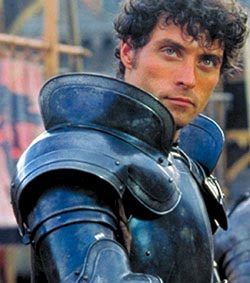
The bad guy (Adhemar) isn’t really that bad when compared to the bad guys that my grandson sees at his dad’s in other sci-fi adventures. He is a jerk, yes. And, he cheats to win. He’s an elite snob. But he doesn’t try to rule the universe and he wasn’t enhanced by any super power what so ever. More importantly, he doesn’t kill. In one scene where he ‘tips’ his lance with a hidden sharp point, and that point drives through William’s old armor at the shoulder joint, and the armor is removed after the run, there is only a small amount of blood and it’s obvious no life threatening event took place (another continuity error in this scene - when first shown, the padding under the armor has a hole with blood around it, moments later the hole is gone and only a little blood remains).

We do see a naked man’s butt from behind and from the side, but it’s done in a way that’s not shocking and no frontal nudity shows at all. The character reinforces well the idea that people should not be naked in proper society, and teaches the lesson that gambling is bad for a guy. One can, quite literally, lose the clothes right off your back. My grandson vocalized the moral lesson learned right after the gambling in town scene. I was impressed at how well he understood the concept, relating how unfair it was for the gambling friend to expect someone else to pay his way. As the boy said .... that’s just not right. The character learned and behaved quite admirably the rest of the movie and my grandson noticed that.

Of course, how could I mention this movie and not talk about the music? That part of this creation, I think, was brilliant and I knew it would give my grandson the emotion of the story, especially if he couldn’t understand all the words that were being said ... which many times was the case for him. Take, for example, the thread that asked early in the film, “What do you mean, dead?” The reply simply stated, “The spark of his life is smothered in shite. His spirit is gone but his stench remains. Does that answer your question?” Combine those clever words with a strong English accent and you have gibberish a child will not understand. My grandson asked me, “So, is he dead?” To which I replied, “Yes.” Early in the film we had to clarify what was happening.  Soon, though, the intent and story shone through well enough for the boy to understand what was happening.

I imagined this movie would do for my grandson what Romeo and Juliet did for me as a kid (That movie also showed a butt, by the way, go figure). If the story was filmed perfectly, and the actors played their parts naturally well, then a good understanding of the tale will come, even when verbal comprehension is lacking. That did happen with Romeo and Juliet for me, and it happened for my grandson in A Knight’s Tale.

The music in the film gave everything to the emotion of the players. Watching fans in stands at a jousting match as they clapped and chanted along with Queen, singing  We Will Rock You loudly; or seeing William and the Princess dance to David Bowie’s Golden Years was rather funny, considering the costumes and such, yet it definitely enforced the attitude of the people in their time. We related to the emotion immediately and it didn’t feel weird at all. Just ... funny ... and entertaining. Brilliant. If they would have played a renaissance ditty my brain would not have gone to the energy driving rhythm that fans produce at sporting events. It was important we felt like we were working our way to the superbowl of the day and this film did that better than ever.


In the end, my grandson said that was the best movie ever. It’s his new favorite and he’s said a couple of times since that he is going to change his stars. He may not totally understand what he is saying, but he’s got the idea that he can control his life. I think of the line William’s friend said to him when he first heard the plan for future glory, “We're the sons of peasants. Glory, and riches, and stars are beyond our grasps. But a full stomach, that dream can come true.” We will never better ourselves with that attitude, and I think my grandson understands that on his elementary level. My tough job now is to find more entertaining movies to watch with him that will reinforce it.

** Don’t forget to fast forward through the credits at the end. There is a fart joke that really captured the little one’s funny bones ... we had to watch that little snippet 4 times.

Saturday, July 17, 2010

Ghosts of Artist Past

Sometimes I read movie reviews and wonder how a person gets a job like that. How can they be paid to put words to paper that bash creative ones, or pump-up others to an insane degree? More importantly, why is it that a movie’s success depends on the critics at all? Couldn’t a great movie withstand the hoopla of critic bashing and still perform well? Unfortunately, most of the time they don’t, especially if that movie was not produced in Hollywood. I’m going to introduce to you what I think is a great movie that critics have soundly trashed. There will be some spoilers in here, but knowing parts of the story will not ruin the movie for you. This film is fiction based on truth and I think the human behavior aspect of it is simply priceless.

Goya’s Ghosts (2006) has several elements that made it attractive for me.  First positive element: It is a story told from an artist’s point of view and that’s a natural interest for a mind like mine. I love art … particularly art history.  Granted, Goya is not one of my favorites – I find most of his work repulsive and dark. But, why wouldn’t it be? He lived through the Spanish Inquisition and saw things few humans could stomach, so of course his paintings colourfully depict brutality and nightmarish visions.

Francisco Goya is fascinating in the sense that he is regarded as both the last of the Old Masters and the first of the moderns. He was a painter of royalty on the one hand, and a macabre printmaker on the other, whose prints created images depicting, what he called, “...the innumerable foibles and follies to be found in any civilized society, and from the common prejudices and deceitful practices which custom, ignorance, or self-interest have made usual.”  They were very dark visions.

The movie does a fabulous job showing the artist working at his craft ... it is played so naturally that you don’t realize what you are seeing. Printmaking, for example, is shown step by step with process explained through doing. The same holds true for oil painting and sketching. As an artist, I appreciate a certain ‘realness’ when art production is shown and I like to understand how things are made. Goya would have painted just as it was played for the movie – it’s a very traditional process that has nothing to do with the modern directive of inner visions or personal emotions. It is always delightful to watch an artist properly work in the context of actual historic processes.

Second positive element: The movie was directed by Milos Forman. A few of my all time favorites where directed by this man and his sense of visual interests and story-thread certainly appeal to me … One Flew Over the Cuckoos Nest. The People vs. Larry Flynt (a surprisingly good movie). Man in the Moon. Amadeus … Every one of these is a psychological study of human condition and reaction. I did not doubt that Goya’s Ghosts would deliver in that respect as well.

After a few Milos Forman movies I found myself wondering what it was that drove him to concentrate so intently on the psyche of an individual human mind under stressful conditions, and how it relates to others’ minds as they weave and interact through life. Most notable in his history is the truth that his parents died in a concentration camp under Hitler’s regime. Could that be his driving force? Perhaps. Certainly, I’ve never seen another who could so effectively develop a stressed character like Milos can – a character that is intensely portrayed by the subtlest of gestures, the nuances of body language, the inflection of vocal tone. I do not understand how he draws this quality from actors, he just certainly and consistently does it.

Third positive element: The movie was produced and filmed in Spain, not a Hollywood production. Hollywood can tire me sometimes, with their fast paced and visually intense productions – especially with epic historical dramas. I do enjoy costumes and panoramic sets, though sometimes those can overwhelm the story. This tale was about an era that was grungy, harsh, yet beautiful. Having Spaniards tell  me about it would add a bit of authenticity, and I liked the thought of that. It could feel grand without trying so hard and every detail in the backdrop could be just right. I was eager to experience Spain.

Forth positive element: Critics absolutely hated it.  I think it is one of the most dissed films I’ve ever read about in reviews (right up there with Amelia). None complained about the acting, nor the costumes and sets, in fact they liked that stuff. They just expected more and complained that it was undercooked. I don’t know what that means.

Here’s the truth about this film. It’s more accurate, historically, than most any film out there. There were only two glaring errors that I could see: One, the film begins in 1792 with the inquisition examining the “Los Caprichos” etchings. Goya did not create those until 1797. Two, when Goya unveiled the unflattering portrait of Queen Maria Louisa she was deeply offended and huffed out of the room. In reality, she loved the painting so much that she promoted Goya to first court painter. Both of those twists on reality where done to direct the story certain ways and I got through them without complaint. This story wasn’t a biography of Goya’s life and career. It was a study in human behavior and it involves three characters that are figuring out how to survive a time of extreme chaos and turmoil.

Visually, everything worked. Natalie Portman was cast as Ines after Milos Forman recognized her likeness to the girl in Goya’s painting “Milkmaid of Bordeaux”. She played a wealthy merchant’s teenage daughter whose portrait was painted by Goya, and who also sat for him as a model for angels in public murals and such. Portman does her part so well one could say she actually plays three roles in the film … pre-Inquisition Ines, post-Inquisition Ines, as well as her grown daughter, Alicia. There is a certain madness that Milos seems to appreciate and showcase, and Portman naturally provides that element to the film. She does hold a bachelor’s degree in psychology (Harvard) so I suppose her mental probing of the character would be the expected thing for her to do. She does seem to delight in the insanity of it all. There are times when you watch and think, man, the girl is completely mad and moments later she comes across sharp and clear, very aware of what is happening in her world. She sort of fades in and out of reality as the story moves along, in a not so obvious way. It’s brilliantly played and rather charming, in a weird kind of way. I ended the film feeling empathetic for the Ines, and loving her for all her madness. It’s funny … I reflected Goya in respect to the girl and found myself thinking about her for days after I watched the movie.

As for Goya, Stellan Skarsgrd looks very much like the painter. What I enjoyed about him was the complete normalcy of the man, both in appearance and in action. He was simply a painter who networked and searched for whatever commissions he could find. He was not a handsome and dashing Spaniard (as Hollywood probably would have cast him), just an average looking fellow who finagled himself through the chaos. He was portrayed as decency incarnated, which is everything I imagined Goya to be.

The third arm of the triad of characters is Lorenzo, played by Javir Baldem. Lorenzo is a person that is easily hard to take, yet as his character developed I began to understand his motives, and I did wrap myself around his persona before the movie was through. I liked Baldem in this role … a lot. He has a nice perspective on his job as an actor, once saying, “I truly believe that what I would like to portray on-screen are human beings, and human beings usually are not as handsome as movie stars.” Again, it’s all about personality studies and this movie was perfectly cast. Just watch the transformation of Lorenzo, from the opening scene to the last ... it is an astonishing journey of a man searching for conscience of faith.

The historical setting for this movie is huge. We experience the rebirth of the Spanish Inquisition, then turmoil at the end of Catholic rule as Napolian’s army invades and conquers Spain, and finally England barrels in and frees the Spanish from French occupation, and the liberated ones bring back Catholic rule in the end. What a waste through war, is what we see, and all things that turn around come around again. Goya’s etchings, which are shown throughout the movie, reflect things he witnessed – both the brutality of war and life in 18th century Spain. What Goya drew and painted is shown on film and whether you realize it or not, his eyes directed Forman in respect to set, just as Forman’s mind directed the psychology of it all. And, throughout that process, the three primary characters are continually finding each other’s orbit as we walk through this truly disturbing part of history.


I wonder what critics are thinking sometimes. Are they more concerned about a movie being enlightening, or cutting-edge, or faster or brighter or louder or more animated than the last one, or … what? What does under-cooked mean, anyway? The movie is almost there? It’s not well exicuted? One theme I caught through all the reviews I read was that every one of them missed the entire point of the film.  This is NOT about Goya or his muse. The title even states that clearly. It’s about ghosts. Not Goya’s ghost.  Goya’s ghosts ... more than one haunting person that belonged to the man. It’s not a history lesson about the ups and downs of the Spanish Inquisition, either, or foriegn occupation or political upheaval at all. A ghost is not events or time or space or subject matter. It’s a haunting person. More than one is haunting people. … and haunting generally indicates a troubled soul ... unable to rest.

When watching a movie like this, which is really a movie about pshychological evaluation/penetration, I find myelf examining things like being ‘put to the question’. What would I do should that have been me? Whould I say I love pork after all, or that my mother was a monkey? Or would I hold faith so dear that I’d suffer the pain? I must ponder piety, morality, civic duty, and basic survival to find that answer. And even then, I know I would have to live it … to feel the pain for the truth of it all is more than I can imagine.

Grasping this concept is not hard. Goya was an artist who chronicled a time. His paintings and drawings share with us what touched his heart through eyes that saw things few ever see. His ghosts are with us today – on his canvases.  He gave us souls who struggled and suffered and most did not survive. His people. His country. Ines could easily represent his homeland as a victim who never gave up. Lorenzo would be the heart of the country that forever searched for conscience. And Goya is the steady and decent soul.

You must look at this movie from an artist's eye and it will make more sense than any critic can imagine.

Sunday, July 4, 2010

It's Not Easy Being Green

I saw something very strange the other day ... it made me stop and stare in a way that I knew was impolite, but I couldn’t help myself. Walking along the sidewalk was a young man, somewhere between the age of 15 and 22 (It’s hard to tell these days). He was very skinny and looked like he’d never had a healthy meal in his life. The pants he wore were baggy-assed jeans, where the crotch came in at the knees and boxer-shorts stuck out the top (still showing butt-crack, go figure). His body looked twice as long as it should have been, and his legs appeared stunted (reminding me of Dorf, that very funny character Tim Conway used to perform back when). I wasn’t sure if his slouchy posture had to do with simple laziness, or if it were an effect caused by trying to keep his pants up (either way, when that kid gets old he’ll be shaped like a letter ‘c’, no doubt). Adding to the silly effect of body proportionment, he walked with his legs spread as far apart as possible (which wasn’t that far - his crotch was at his knees, for cripe’s sake), not bending his  knees at all ... just a waddle, like a penguin out of water. I actually laughed out loud for a moment.

As I watched him I thought, “How strange. Is that good looking today? Does he gaze in a full length mirror in the morning before he goes out and say ... damn .... I’m hot?” And then I wondered, “What is wrong with young people today?” That frightened me because suddenly I sounded just like the old people did when I was a teenage girl. Crap.

As usual, one little visual like that can make my mind ponder and cogitate so many different things. No matter what angle I thought about, things always came back to a notable point. I was trying to figure out exactly when it was that our sense of good taste collapsed.

Good taste is relevant, I know. So are good art, good movies, good books, good music, and anything else made from a creative mind. I had this debate in collage years ago, where an art history professor tried to convince me that the isms of our times were brilliantly conceived by exceedingly enlightened individuals. I thought not then, I think not now.

But, let’s think about this kid for a moment. Let’s average what I thought and say he’s 19 years old.  What was it like for him to grow up? He would have been born in 1991. He would have been terrified at the year 2000. (Y2K, remember?) He would have grown up with computers and 180 or so channels on his tv. In school he would have sat at round tables with 8 other kids and the smart one would earn the grade for them all (this kid wasn’t the smart one, I could tell - and yes, I’m profiling - that’s ok, too). Political correctness would rule his day and dooms-day prophecy regarding earth and warming and destruction would all pick at his little brain. The only presidents he would have known were named Clinton or Bush. His early years were much different than the early years I experienced.

I was born the year the Berlin Wall was erected. I was terrified of the Russian communists and the cold war kept our bomb shelters fully stocked and loaded. Computers were a fantasy that blinked and blipped on Star Trek; and I typed on an IBM monster of a machine learning finger positions and speed without errors (I could compose and type a formal business letter before I hit puberty). Television, on a good day, gave us 3 fuzzy channels and programs made family friendly the only game in town. In school we sat at single-student desks, in neat alphabetically ordered rows. I even had to take etiquette classes where I learned table manners and how to eat soup without slurping. Polock and Irish jokes were heard daily and dooms-day prophecy regarding earth and cooling and destruction would all pick at my little brain. The presidents I knew were Nixon, Carter, and Reagan (kind of a conservative, liberal, conservative treat; where Carter was the gooey center between a couple of really tough cookies). But, there was something else about my childhood that is missing for people like that 19 year old I saw wabbling down the sidewalk.

When I was in third grade a visitor came to our school and performed a puppet show for us kids. It was a charming presentation; funny, thoughtful, and held my attention better than most things could. The puppeteer’s name was Jim and he was promoting a new show that would begin airing on television soon. He wanted us to tell our parents about it, and hoped we would watch. After his performance we were allowed to go speak with him if we wished; ask questions and look closely at his puppets. He sat on a folding chair near the middle of a large gym. Most kids sprang off the bleachers and headed for the playground, running widely around the fellow who just spent a good while entertaining them.

I was very curious about the puppets and shyly walked over to the bearded man. “Hi.” he said as he smiled at me. “Hello.” I awkwardly replied, very quietly. I wasn't comfortable talking with a strange bearded man and he could tell. So, he switched his voice to the puppet’s on his right hand, and the imagined creature with his happy-go-lucky attitude spoke directly to my face. “What’s your name?” the frog asked me. I blushed and tried to stare at my feet as they shuffled. But, I couldn’t help but look at the puppet. It was making faces at me … cocking it’s head and puckering and crunching it’s nose. “I’m Kermit. Did you like our show?” I shook my head yes and found myself really rather amused by this ... sock of a thing that somehow seemed alive.

My shyness was lessening as I leaned in and tried to see how it was made. The frog leaned into me and began checking out my head. Startled, I jerked back and shot a quick glance at the puppeteer. He was pretending not to see me and I was getting a bit annoyed by it all. I did not like being teased, so I glared at him, furrowing my brows to really let him know I didn’t like him after all. The puppet raised his voice a little, “Hey! Can I ask you something?”  I looked back at the frog who appeared to be staring at me, tilting his head a little while he waited for me to answer. After a moment, I nodded a little yes, feeling more embarrassed and hoping none of my school friends were seeing this. “Why’d the elephant sit on the marshmallow?” he asked. Paleeeze … I thought … that is the stupidest thing I’ve ever heard. I pursed my lips and stared at the puppet, not saying a word. “Huuuummm....?” the frog urged me on. “I don’t know.” I finally whispered. “So he wouldn’t fall in the hot chocolate!!” Kermit joked, then he laughed and laughed, mouth open wide as he bounced, his arms flying about. It was infectious, and before I knew it I was giggling with the frog.

When he calmed from his own self-amusement, he began chatting with me in a rather adult way. “What do you like to do,” he asked? “I like to draw pictures.” The conversation went on as I explained how I found master paintings, and how I liked to copy them. And I wanted to grow up and be a master painter, too ... even though I was a girl and everyone says girls can’t do that. We actually dialogued as the puppet flowed with expression and questions for me. Kermit gave me some really good advice. He told me, “Do what your heart wants you to do. No matter what anybody says, your dreams are yours and if you think you can do it, then you can do it; even if you are different from other people who paint. That’s ok. Look at me. I’m green and you still talk to me.”

Somewhere during our conversation I ended up on the puppeteer’s lap and became so engrossed in my moment with a very grown-up cloth-frog that I didn’t notice anyone else in the gym. Something snapped me back to reality and I looked around, suddenly realizing that very few people were there. I was the only kid left. The puppeteer was smiling with the kindest of eyes as I timidly said to him, “It’s just a ... puppet.” And Jim said, “A puppet that tells the truth.” I hoped off his lap and said goodbye to the frog, promising them I’d always remember and follow my dream. And Jim Henson rubbed the top of my head and encouraged me to keep practicing my drawings so I would become the painter I wanted to be. And I did practice harder because I believed them … the frog, and the man that could make it talk.

I watched the first episode of Sesame Street because Jim would be performing Kermit and I loved to watch the magic of a new way of puppeteering, not to mention I felt like they were my friends. I saw every show I could, and was delighted to share them with my children when they were small. Grover taught us all so much, and Grouch and Cookie Monster were simply delightful. We ended up watching full featured muppet movies and a prime-time adult comedy show. The success of the muppets was historic and astounding, and it proved to me that every word Mr. Henson shared with a little 8 year old was true.  He became the greatest and most well known puppeteer in the history of the world … because he lived what he preached.

And then, in 1990 at the age of 53 ... he died unexpectedly. I was stunned. I couldn’t imagine life without Kermit and I spent some time reflecting on why I was so incredibly sad. I was lucky to have met them when I was young, and I felt a certain pride in all the successes that Mr. Henson found. He wasn’t family, but he sure felt like a friend.

My kids were young enough to still appreciate his company’s work and I tried to remain open to the idea that another voice was playing Kermit. I’d have to bite my tongue when the frog appeared. It wasn’t my frog anymore. This one would belong to a new generation of people, not mine.

Sometime later I saw Kermit being interviewed by several people, among them was Jay Leno. I don’t like Leno, I find his humour sexist and crude and, frankly, I can live without it. Not surprisingly, he could bring out the worst in the new Kermit. Sex jokes and nudity humour was unbecoming for the frog and I’d get angrier each time I saw stuff like that. I stopped watching anything Kermit or the muppets a few years after Henson died, and I’ve never regretted it. I rather like the frog and man I met when I was a kid and I prefer to remember them that way.

How does all this relate to the 19 year old and what he never experienced as a kid? It’s really simple, in a complicated way.  Our culture has become such an ‘anything goes’ place that dress or hair or tattoo, or whatever, can’t shock the meekest of us any more. Sex has infected every aspect from movies to videos  and books, and even children’s show characters. People are the complete opposite of beautiful, in looks and behavior. It’s like we’ve given up sensuality for dirty nudity and it’s come to the point of ‘who cares?’ anymore. They’ve made viagra for men to get them excited, and now they’re developing it for women, who need the sensuality more than ever in this very crude society. The fix isn’t drugs or pills or dirty naked people. The 19 year old may never figure this out, because all he’s ever seen is this modern side of chaos. That’s too bad for him. It’s pretty nice strolling on the beach, holding hands, talking sunsets with a person you love.

There was a time when clever words or general appearance invited appreciation and respect. And, those of us being inspired had a better life because our heroes cared about us and taught us well. I would bet dimes to dollars that the 19 year old’s heroes only care about themselves, or their own fame and how much money they can make from absolutely no talent. I hate to sound like the old people of my youth, but I’m saddened by what I see out there.  Kids, like the 19 year old, who have very little respect for themselves, spend most of their time with a ‘bud’ in their ear, a video on their ‘pod’, and talk only about winning a never ending virtual game of fantasy war. Their world is violet and ugly, in an imaginary way, and that sort of creativity is destructive as hell. It certainly doesn't help it's students become the very best that they can be and with those thoughts I say thank you, Jim Henson, for inspiring so many little ones while you were here.

Tuesday, June 22, 2010

Do Women Yearn to be Tamed?

Not too long ago I was discussing the women’s movement with my older daughter. From her point of view that movement has done more harm than good to the family structure of America, and she yearns for the day when women can stay home and be mothers and wives again. Part of me agrees with her. I’ve spent some time trying to imagine what it must be like for girls her age ... to never have known pointed and hurtful sexism on a very personal level. To be thought of as second class citizens. To never have a credit score of your own. To be so dependent on a man that basic things, like owning a home, are beyond your reach. She has grown up knowing she could be anything she wants to be and all is possible for a girl. I am glad she has that, though I do recognize that now most women have to work outside the home, married or not, and that does hurt the structure of a healthy home-life for kids. For those who wanted to keep the idea of traditional womanhood alive, we have, for the most part, failed them.

I grew up fighting for the right to work and did my share of tough assignments. I was ‘first’ woman on several jobs, standing my ground through pickets, insults, and flying objects. I never thought about the real long haul of it, only about the moments when I knew I could do a job better than the guy standing over there. And I did my best, always.

My job for a long time was commercial illustration and product development (1990s - mid 2000’s). In that position I had to think about who decided on what to spend disposable income. It was generally understood that women held the pocket-book keys ... or, at least she’s the one men would have to persuade should he want a specific toy or treat for himself. And, most significantly, she was the one the children would bug until she caved. On one hand, it felt like developers believed women had a lot of power in the home. On the other, I understood very well that women were being profiled as a group, and we were evil bitches who didn’t want to be persuaded and fawned over. I kid you not, product development meetings really were all about how to trick a woman into parting with some money all while we adhered to the new politically correct thought control standards. We analyzed colour trends, marketable subject matter, style ... all things that made up a package for toys or food or whatever.

The idea that I participated in those meetings is really rather bizarre, when I think about it now. I worked for top international companies and my images generated hundreds of millions of dollars each year. I was sought after and held marketing secrets close to chest. I wore a hat that said, “Respect my authority”.  I wore soccer shorts and a Xena tee-shirt that read, “Chicks Kick Ass”. I had product developing men hit on me, and lesbians, too. It was a brutal job, really, and one I was somewhat happy to leave behind. But, even though it’s not my duty anymore, I still think about trends and look for marketing angles all the time. How we sell things says everything about who we are as a society. And with that in mind, I’ve been searching for vintage ads with the intention of sharing with my girl how women were viewed before. Old ads will tell very well why many young girls joined the women’s movement during the late 1960s and 1970s.


For example, look what the 1970s did to Levi jeans. It’s bad enough they pin-striped them, showing two Woody Allen-looking dorks standing in near super hero poses – what is that woman doing there?... in a bikini, to boot, nestled right between the leader of the pack's legs? She’s small and subservient, barely dressed, and looking ever so lustfully bashful. No doubt, men were in control when this ad was made. They could tell a woman what looked good and they knew how to dress to catch us. They also knew what to drive:


What about that nearly naked lustfully bashful gal that sits nestled between a fella’s legs?  She’s a spirited woman who’s yearning to be tamed.  Just like a Subaru. A man would feel pretty good knowing he could drive either one of these things home. But, he’s got to catch that gal’s attention first, reel her into the Subaru so he could take her home, or to a motel ...


Yes. What woman doesn’t like second hand skinny cigar smoke blown in her face? I know I’m getting all tingly just thinking about it. A puff in her direction and she will follow a fella anywhere. The only thing finer than smoke blown in your face is kissing an ash try and, frankly, I think they dropped the ball on this ad. She’s leaning into him, yes, yet her eyes are not rolling back in shear delight and anticipation. Because, you know, once that gal follows the smoke to the fella and then slides in beside him in the Subaru, taming can commence, with or without the motel room ... and that man is prepared:


Wow. I don’t even know what to say about this one. Women are slutty, always have been? We pack the diseases? We can’t resist any man? I think this ad was made especially for very optimistic men. I know I’ve met a lot of those in my life and, honestly, they never needed what this ad promotes ... they pack those things in their wallets just so other guys believe they tame the wild girls. Trust me, all you men reading, they don’t.

Normal fellas? They didn’t bother with the rain coats. They instead put on their most powerful scent. [And, why does this ad say at the lower bottom, left corner “Found in Mom’s Basement”? Does the shape of this bottle and that little remark imply what I think it implies? We women are really, REALLY, wild and sexual animals – so tame us!!]


I nearly lost my train of thought with this one ... sorry, it’s hard to keep my composure through this ... to re-cap, Levi’s are pressed (mom did it, in the basement), irrasistible scent is on, the fella hops in his Subaru and, while puffing his skinny cigar, makes haste for the nearest library. You know, that place where really wild single women work. It’s one of the only job gals are allowed to do.


He rescues the long legged lady from that bore of a job and soon becomes the center of her world, because there is one thing he knows ... he’ll always be hungry without her.


That’s a good reason to own a wife, don’t you think? The fella did dream long and hard about an alternative and that made him happy, but he is a realist in the end. It’s illegal to have two of them, after all, but a fella can dream even after he’s married.


Oh, yeah ... those ad makers dreamed ...


... and dreamed ...


and made us feel completely inadequate, weak, and stupid.


And the best thing he could do to pick up our spirits is ...


give us and our newborn some beer.

In the end, men remembered one rule that changed their world forever ...


Go figure ...


It’s important for young women to realize that we gals who supported and pushed for women’s rights weren’t people who wanted special treatment. We didn’t want to become men, nor did we wish to give up femininity or the option to choose a family life. We simply wanted to be recognized as equal people who are capable of many more things than we were allowed to do. We expected to have to prove ourselves, just as men did. And we wanted paid the same for equal work. We wanted to buy a house, or a car, or hold a credit card with our name. We wanted our own name. I wanted to be Olivia Schemanski, not Mrs. Christopher Schemanski. And, it’s not because I was ashamed of the man I married, I actually adore him. I just wanted my identity, too. But I never dreamed we would lose so much by gaining what we thought were reasonable rights. I think the world functions like a pendulum. We keep swinging to the extremes and I don’t think that's a very healthy way to be. Why can't we calm that pendulum?

Tuesday, June 15, 2010

Extraordinarily Ordinary - What Do Dreams Know of Boundaries?


A new movie about Amelia was released in October, 2009. I, of course, waited patiently for the film to be released on DVD so I could bring it home and enjoy it at my pace, with my own really cheap and lightly buttered popcorn. I had a hunch I was going to like this movie simply because the reviews that followed it’s opening gave insight regarding style and content that actually sounded great to me. I’m going to spend a moment or so with critics’ words, if I may, and defend a movie that has been brutally bashed since it opened. 


 Frustratingly old-school; Hollywood-style Entertainment Weekly:
Ok, I understand that today many people like fast-action-jerky film work, or weird experimentations from the ‘sundance’ crowd. Truth is, some of us completely enjoy still-camera cinematography; we like to build a story visually, piecing things like costumes, sets, and audio tracks together with a steady, and I mean steady, accumulation of information. Perhaps that is old school, but I’m old so who cares. I like it. In Amelia, it’s one of the most charming aspects of the film. I can watch it and not become nauseated, which is amazing because I hate to fly and there are a lot of shots that are way up there looking down.


• The movie is imprisoned in safety NPR:
The movie stays right on the truth the entire film. It ignores urban legends and myths and, instead, concentrates on a nine year span of Amelia’s life which is mostly shown as her personal reflection of events that brought her to that fateful flight in 1937. She is winging around the world while she remembers. What else would the woman have done? If I were in her shoes I would have been full of retrospect, and this point-of-view has to limit the story to an absolute and safe place. Amelia’s diaries and log-books were heavily quoted and the voice of the aviator comes across clearly, even ordinarily quaint some times.


• The script smoothes over the many controversies surrounding her life, including her open marriage to Putnam, her rumored bisexuality, and whether or not she was a spy. Jezebel
Oh, my ... um ... let’s start with the open marriage. Yes, Amelia and George had an open marriage, which was more than unusual during their day. The proof of that is the letter she wrote to Putnam when she finally accepted his sixth marriage proposal.

"You must know again my reluctance to marry, my feeling that I shatter thereby chances in work which means so much to me. . . .In our life together I shall not hold you to any medieval code of faithfulness to me, nor shall I consider myself bound to you similarly . . . .I may have to keep some place where I can go to be myself now and then, for I cannot guarantee to endure at all the confinements of even an attractive cage."

The movie showed her writing that letter and giving it to her husband to be, and the idea of an open marriage was covered pretty well in this script. The only things missing were wild sex shots and in your face social judgments and lecturing. Frankly, I don’t want to imagine Amelia doing that and, in my opinion, she never did. Listen closely to her letter and you may hear a gal who was concerned about being owned. Remember the year (1931); understand what was expected of women back then. Amelia was fiercely independent and wanted to remain that way. She wanted to fly.

As for bisexuality and being a spy? That is pure speculation not founded on any provable truth. For folks who want to see this sort of story, you ought to write a script and call it Stella ... base the story-line on Amelia but add your fantasies for fun. You could have your steamy Ewan McGregor sex-shots, sultry leads, wild explosions ... CGI the plane ripping apart as it bounces across the ocean, what the hell. Stella could parachute out in time (not the navigator, though ... a man would not think quickly enough) and land on an itty-bitty South Pacific island, be a castaway for a while surviving by her own American-heartland-wisdom, drinking cocoanut milk and eating killer crabs she wrestled with her bare hands before the Japanese found, imprisoned, then lastly shot her dead-by-firing-squad for being a spy.  Dammit! That is filmmaking -101 ...

But that’s a different story ... let’s get back to
Amelia and the critics.


I'm not suggesting that Mira Nair should have invented anything for Amelia. It is right that she resisted any temptation. It's just that there's a certain lack of drama in a generally happy life. Chicago Sun Times:
This movie is not about Amelia’s life. It’s about a nine year span that lead from the first woman to sit on a plane flying across the Atlantic to a woman who was piloting a plane while trying to circumnavigate the globe.  Yeeesh ....

There are aspects about Amelia’s early life that are very interesting to ponder, and they follow a trend most surely. For example, Amelia did not grow up in a normal home with mother and father. She was sent to live with her grandmother, then on to finishing school. Dad was an alcoholic and that unsettled Amelia’s world on many levels. The same kind of thing was true for the other strong ladies I wrote about earlier in
There’s No Crying in Baseball. Dottie (Dorothy Kamenshek) went off to play baseball at 17 years old. I can’t find any information about her childhood or family relations, but how many 17 year old girls would have been allowed to go alone to Wriggley’s Field to play baseball during WWII? And then there’s Donna Hillman-Walsh, who grew-up the daughter of a Hollywood starlet and was sent away to finishing school at 14, then headed out to New York to learn how to race thoroughbreds. Research either of these ladies and you’ll find very little information about early family life and relationships. Truth be told, all these girls were extremely independent tomboys who’s goal in life was to be the very best that they could be, doing what only men were allowed to do. All were highly motivated, and all were very good. I would be interested in watching a film or documentary about this sort of stuff. But not in a film about a nine year span that lead to Amelia’s final flight. For now, let us focus on this movie and understand that Amelia was generally happy to be flying. Ok. What’s wrong with that?

•  Amelia is a by-the-book bio-pic. By following the template, it's as safe and straightforward as one could possibly get, without narrative flourishes and with minimal exaggeration to satisfy Hollywood's appetite for fictionalization. Reel Views

YEAH!!

•  When it comes to some of the wild speculation that has arisen over the years about what happened to Earhart during that final flight, the movie doesn't even go out on a limb, opting instead for the sort of vague, open ending that, is historically safe and cinematically dull. The Washington Post:
It is true, this movie does not dare to try to answer what happened at the end. Amelia simply flies away. This movie is true on fact and as such, how could it speculate an ending?


•  ... old-fashioned, star-powered bio-mush Variety:

•  ... an object lesson in the follies of the conventional biopic, which puts mindless recapitulation of historical data above analysis or insight.  A.V. Club:
Did this critic just say that opinion should rise above historical data? I say, save the imagination for fantasy scripts. A film like Amelia should be held to standards of accuracy just in case some young person who knows nothing about Amelia sees it! Entertainment can teach and there’s nothing wrong with that. In fact, wouldn't we be prudent if more films aimed to educate?

I could go on and on with these reviews, but you get the point. How about we simply consider the film without the disappointed critics’ ramblings about what they wish it had been. True, anyone who ever researched Amelia knows the story going in, and comes away with no new information. The tale is what it is, why expect more? If you can’t handle that sort of thing don’t bother watching this movie. You would miss a beautiful film if you opted out, though, and just seeing the old-time news reels morph into modern day, full colour actors is a truly sweet effect.


Hilary Swank does a marvelous job becoming Amelia, though at times I could swear I heard Katherine Hepburn dialoging in aviator costume. As a girl I had a vision in my head that was Amelia and Swank nailed it for me; her big goofy grin, the confident swagger, the midwestern speech-halting accent, the kind of shy yet public figure, the in-love with her man though not publicly showing it woman.

In truth, there was only one person cast in this film that I wish had been just about anyone else. Whenever I see Richard Gere (he plays Putnam) in a film I see only Richard Gere, never the character he’s trying to play. The sets, costume, and filming technique all took me back to another time and I loved that. Richard Gere would rip me right back to my time and I hated that. George Putnam was a ground breaking fellow who, with Amelia, presented the very first public relation/image building situation and made her a star. He had a certain charisma and style. Richard Gere is frumpy (I thought so back when I first saw him in American Gigolo, I’m just sayin’). And, not even considering his acting, the guy is just too old for this one and does not look good in 1930s costume. Still, even with that, I like this film very much and would recommend it to anyone who wants to know about, or simply remember, Amelia.

As for her fate and the open-ended conclusion of the film, I think it’s our job to research and dig and learn. For sure, the truth is not settled yet, though many people think they know what happened. Some still cling to spy notion, others to the drowning theory, and some (like me) are convinced that Nikumaroro (Gardner Island) will prove once and for all that Amelia Earhart was a damn good pilot who didn’t survive because the United States Navy failed her.

Consider all the evidence I mentioned in part one of this story, and add to them this:

• Amelia’s last radio contacts where strong and clear, which indicated she was very near Howland Island and had the seaman on duty the night before not left certain tracking equipment powered on, the battery would not have been dead and the Navy could have pinpointed exactly where she was during every last moment of her flight. (yes, this is shown in the movie)

• Amelia’s very last transmission said   "We are on the line of position 157 337. Will repeat this message on 6210. We are running North and South." That put the Electra on a navigational line that coincides with the Phoenix Islands, with Nikumaroro (Gardner Island) specifically. The plane had more than enough fuel to get there, and the tide was low and the island’s reef was dry during the time they would have arrived, and that island is much easier to see from air than Howland. The reef is big and smooth enough in places to permit a bumpy, yet safe landing. As far as Amelia knew, the navy could track her. Landing was a smart thing to do.

• Credible radio distress calls were heard over the next four nights. Those transmissions coincided with times when the tides were low enough to allow prop clearance for an Electra’s engine to run. Why is that significant? The engines running at a certain speed would charge the batteries needed to send out signals. And, if the plane ditched into the ocean no signals could ever have been sent. All electrical systems would have failed if the plane did not sit on land, with undamaged landing gear beneath her.

Directional bearings of nearly 200 distress calls, taken by Pan American and the US Coast Guard, pinpointed those distress signals in the vicinity of Nikumaroro (Gardner Island).

• US Navy search planes did not fly over that island until a week after the plane disappeared. By then, distress signals had stopped. The pilots of the search planes noted “signs of recent habitation” on this officially uninhabited island. They saw no aircraft, but a photo of the island taken during the search shows the tide was very high with rough surf on the edge of the reef. If there were an aircraft on that reef, it would have been hidden by the surf.

• A colony was established on Nikumaroro (Gardner Island) in December, 1939 and residents from there report that aircraft wreckage was on the reef, as well as in the lagoon, when they came. They, apparently, stripped many parts from the crash and used them to fabricate things for themselves. A US Navy pilot saw island locals using an airplane control cable as lead fishing line. He asked them where they got the cable, they said from the plane wreckage that was there when they arrived.

One part of the Amelia story that truly annoys me are the words repeated by the fellows who let the lady down. They were very quick to point fingers at her, claiming she was a terrible pilot without the skills needed to complete her mission. Truth is, some fellows simply could not take orders from a girl, nor would they ever accept that a female out-performed them. Amelia was an amazing pilot during the time when aviation was new and extremely dangerous. She did things men died trying to do, and I believe she landed that plane on a small island out in the middle of nowhere, and the Navy did not heed reports of distress signals or take the Gardner Island theory serious in the days following her disappearance. She is my hero, as most strong and independent women are, and I am grateful for sky trails she blazed all those years ago. I encourage you to watch Amelia with those sort of thoughts in mind. 


And we'll leave this post with her words ...


"[Women] must pay for everything .... They do get more glory than men for comparable feats. But, also, women get more notoriety when they crash."


Saturday, June 12, 2010

Extraordinarily Ordinary

There are names that always stir the imagination. Zorro brings visions of a black mask, cape, horse, and dashing sword-play. Neil Armstrong perpetually gives us one giant leap for mankind, and Kermit keeps insisting that it’s not easy being green. For me, there are dozens and dozens of names that trigger cogitation on a wide variety of subjects, revolving around a broad collection of people who inspired a little girl from the west. When a name from my inspiration-list appears anywhere, I stop and read or look and learn some more. Recently, the name Amelia has come two fold.

We all know who Amelia Earhart was; the female champion who flew far and wide to show the world that girls could tame distance just as well as the boys. Her story is the legendary tale of record breaking, cutting edge technology, tough as nails and still as pretty, love and dreams and tragedy kind of thing. I ate that up as a little girl. I wanted to be Amelia. Well, I didn’t want to fly, but I wanted the courage to do what I dreamed of doing; to go beyond being just a girl; to find the bravery to look a challenge in the eye and spit on it.

Young women today may not really comprehend how significant those rebellious thoughts of mine were. Just consider, for a moment, that when Amelia was hired to be the first woman to ‘fly’ across the Atlantic in 1928, she was not allowed to control the plane. She sat in the back and looked out the window. Though she had her pilot’s license, the idea of a female having the stamina to perform a trans-Atlantic flight was incomprehensible. Amelia was distressed by the attention she got for just sitting there:

"I was a passenger on the journey...just a passenger. Everything that was done to bring us across was done by Wilmer Stultz and Slim Gordon. Any praise I can give them they ought to have...I do not believe that women lack the stamina to do a solo trip across the Atlantic, but it would be a matter of learning the arts of flying by instruments only, an art which few men pilots know perfectly now..."


Do you hear that?  She believed a woman could learn the art of flying better than few men pilots knew how. When I was a little girl women still had very few opportunities to pursue any dream that existed outside of the prescribed idea of the perfect woman’s world. She was the first person who helped me understand that in order to play with the boys I would have to be many times better just to receive half the recognition. And, living like that as a girl was possible to achieve.

When I first heard her name she’d been missing for 30 or so years and was still very much an enigma. I loved her ... her tomboyishness, her fashion sense, the truth that she was as ordinary looking as anyone else in the world. And, I loved the idea that she found a man who supported her ambition and was seemingly fine living in her shadow of fame and popularity. Yes, Amelia gave hope to little girls who would rather play with a frog than a doll.

So, as I grew I always acknowledged any new information about Amelia. We all know her Electra disappeared as she attempted to fly more than 7,000 miles across the Pacific Ocean. She had already flown 22,000 miles and this part of the journey would take her to Hawaii, and then to California where she would be praised for two major firsts...she would be the first woman, and she would travel the longest possible distance, circumnavigating the globe at its waist.

But, she never landed for refuel on Howland Island. The world has since asked, “Amelia, where are you?” Several theories continue to circulate:

• Amelia was on a spy mission for President Roosevelt, was captured by the Japanese and forced to broadcast to American GI’s as “Tokyo Rose” during World War II.

• She purposely drove her plane into the Pacific.

• She lived for years on an island in the South Pacific with a native fisherman.

• In 1961 it was thought that the bones of Amelia and her navigator had been found in Saipan, but the bones turned out to be those of Saipan natives.

• Amelia secretly finished the mission then moved to New Jersey, assumed a new name, married a different fellow, and lived out her life.


• And, the most exhaustive inquiry into Earhart’s fate since the US Navy’s 1937 original search has been (and is continuing to be) by The International Group for Historic Aircraft Recovery (TIGHAR), who are attempting to conclusively solve the mystery of Amelia Earhart’s disappearance with investigation procedures that employ rigorous standards of evidence and documented facts. They are focusing on a remote, uninhabited Pacific atoll of Nikumaroro (formerly Gardner Island, which is where garbled transmissions believed to be from the electra happened for 4 days after she failed to find Howland Island) and have recovered physical evidence that suggests the Earhart flight may have landed there on July 2, 1937. In 1940 a partial skeleton and an old fashioned sextant box were found under a tree on the island’s southeast corner. The skeleton was eventually lost in Fiji sometime after 1941, but detailed measurements of the bones indicate that they belonged to a “tall white female of European ancestry”. Other artifacts include improvised tools, an aluminum panel (possibly from and Electra), an oddly cut piece of clear Plexiglas which is the exact thickness and curvature of an Electra window, and a size 9 Cat’s Paw heel dating from the 1930’s, which resembles Earhart’s footwear in world flight photos.  In 2007 TIGHAR performed another high-profile expedition where they were reported to have found additional artifacts, including bronze bearings which may have belonged to the aircraft, and a zipper pull which might have come from her flight suit. All this evidence is circumstantial, but quite interesting when you consider the island is uninhabited.

Today, there is continuing promise with TIGHAR’s research.  That is part one of the two fold that I mentioned at the beginning of this post. TIGHAR’s team will be on the island until June 14, 2010 and they are releasing new finds continually. I encourage you to follow TIGHAR’s 2010: Niku VI Expedition updates, and to read this Discovery News article that was released on June 3, 2010.

New hard truths about the real Amelia continue to tickle our hopes that someday, and maybe soon, we'll know for sure if she was a castaway on Gardner Island. This moment reminds me of the days right before they found the remains of the Titanic ...


(Part two, of my two fold story, will be coming next posting)


Monday, June 7, 2010

A Lesson in History - Rembrandt

From time to time I have an urge to share some truths I've learned over the years. This is one of those posts, which contains adapted excerpts from my book Of Fur & Feathers - An Artist Passing Through


This story is about Rembrandt Harmenszoon van Rijn (July 15, 1606 – Oct. 4, 1669). Rembrandt was a Dutch painter who is generally considered one of the greatest painters and printmakers in European art history. His contributions to art came in a period historians call the Dutch Golden Age.

Having realized youthful success as a portrait painter, his later years were marked by personal tragedy and financial collapse. Throughout his lifetime his reputation as an artist remained high and for twenty years he taught nearly every important Dutch painter. Rembrandt's greatest creative triumphs are epitomized in his self-portraits, in which he surveyed himself without vanity and with unconditional sincerity and truth.
____________________________________

When I was a very little girl I found a mentor. Rembrandt. He was the first master that I copied and when I learned to read I began to understand his history and purpose. Everything he was has everything to do with who I am as a painter today. Why?

In the beginning I had only the pencil. I could hold it and with concentration it would mimic the lines I saw on a piece of paper. Coordination was the first step and, like everything in life before the pencil, it was a doable thing with practice. Basic lines, shapes, and added values were practiced daily. I was limited to only the technique of creation by imitation until words began to enlighten the mysteries of art. Once I could read I began to study everything I could about painting, with Rembrandt consistently remaining at the center of my interest.

In all honesty, I found that Rembrandt and other masters were like gods to me. They were beings who turned simple pieces of paper or canvas into perfect dimensional worlds of beauty and drama. Their humanness didn’t become clear until I could research and dig for the truth. I had to know – what made them so great? Could their time have been so different from ours that their brilliant minds rose above and beyond what simple folk like me could achieve? What gave them such passion to learn to be the best? In all my studies I found there are links from there to here and each master is but one piece of massive puzzle. And, here is one piece to serve as an introduction to a brilliant mind:

Greatness Was Born

Rembrandt was born at a most opportune time, when his world was a newly formed country that pulsed with the fever of expansion and growth. The Netherlands had recently won an eighty-year war of independence with Spain, and Europe was beginning to recognize it as a country in its own right. The artist was born to a miller in Leiden on July 15, 1606, the ninth of ten children. He was the only van Rijn child to go to the University of Leiden (at age 14), and his training there was probably geared towards preparation for fine citizenship in Leiden – perhaps as a preacher, or civic councilman. Or, maybe he was placed in the University to avoid service in the town Militia. Rembrandt’s father had injured a hand as a town soldier, and his oldest brother had problems while in the Militia, as well. As a University student no service was required, and one received a good ration of free beer to boot!

After a short stay, Rembrandt dropped out of the University and enrolled as an apprentice in Jacob van Swanenburgh’s studio to learn the craft of picture making. No one really knows why his schooling at the University was cut short right before its finale; but I imagine he may have found ‘classical’ training boring and desired to satisfy a passion for painting. His parents  allowed and supported this direction for his life.

There are no surviving paintings from his earliest years in that studio but, surely, what he learned there were the basics every artist needed; how to grind paint, size canvases, clean brushes and palettes; and how to stroke with a brush, draw with chalk, and compose a painting; how to render drawings from live models, or make copies from early masters. Swaneburgh had spent time in Italy and surely the Italian influences began for the budding artist in this studio.

Rembrandt stayed with Swaneburgh for three years, then did a brief six months apprenticeship with Pieter Lastman, a famous master in Amsterdam. Lastman had recently returned from Italy, where he was strongly influenced by Caravaggio’s use of lights and darks (chiaroscuro), as well as works from the famous masters Leonardo, Michelangelo, and Raphael. There is no doubt that Caravaggio’s techniques, taught by Lastman, had a profound effect on  the very young artist from Leiden.

After his stay with Lastman, Rembrandt returned to his home town and appears to have opened a studio with a fellow Lastman student named Jan Lievens. In that studio, the two painters often rendered paintings of the same subject, using the same models and props, and their resulting works have been a challenge for historians in respect to attributing certain paintings to either artist. They were friends with the same goal in mind; become a better painter and find success as masters in their own right.

By 1627, Rembrandt began taking on his own students (most notably, Gerrit Dou). In 1629, the statesman Constantijn Huygens, came to the Rembrandt/Lievens studio and purchased a few paintings from each, then secured a commission for Rembrandt that began a series of Passion Paintings for the Court in Hague, which was concluded in 1646.

By the end of 1631, Lievens left for England to become a Court painter, and Rembrandt moved to the new business capital of the Netherlands – Amsterdam. There, he began an association with an art dealer named Hendrick van Uylenburg and found success as a practicing portraitist. He also met and then, in 1634, married Hendrick’s cousin, Saskia van Uylenburg.

It is easy to imagine his life to this point. He was a very young man with a driving interest in painting, and by his mid-twenties he was a sought after portrait painter with a stunning reputation. Success was not only at his fingertips, it was clinch-fisted and strongly held by an extremely confident young artist.

The training that brought him to success is an interesting point. Rembrandt got a late start in his education as an artist. Most young people at that time began at the age of eight or nine and were well advanced by the time Rembrandt apprenticed at his first studio at the age of fourteen. By nineteen he seems to have learned all that he could from Swaneburgh and Lastman and his work quickly surpassed his teachers. Still bucking the established system, he did not dream of going to Italy to learn directly from those thought to be the best. It is said that Rembrandt, when asked when he planned to visit Italy, replied that there was no need for that. All of the old masters’ work was coming to Holland and he could study what he needed right at home.

After he moved to Amsterdam, before he married Saskia, a very significant event happened that tells us much about his disposition and personality. He was commissioned by the Amsterdam Guild of Surgeons to produce a group portrait that would represent Dr. Nicolaes Tulp as the director of a human dissection. Prior to Rembrandt’s Anatomy Lesson, those sorts of paintings held a simple row of men, all looking equal in importance and rather boring. This artist took the composition to a place never before seen. He built a pyramidal setting where each person within the canvas space expresses a different emotion and purpose. Dr. Tulp is the only fellow wearing a hat, and his hands are absolutely perfect and delicate in every way. He was the leader of the group, both in reality and in this painted recording.


When looking at this Anatomy Lesson it’s easy to believe that much effort was made to create a fantastic portrait of each individual man, even the poor criminal whose body is being taken apart for the sake of scientific discovery and teaching - he lies motionless wearing his ashen skin rather naturally.

One element of the painting that is often over-looked, but fascinating none the less, is that the right arm of the corpse is too short when compared to the rest of the body. This is the only imperfection I can find when reviewing Rembrandt’s Anatomy Lesson, and modern x-rays of the arm reveal that it was originally painted as a stump without a hand, which reflects the truth of the situation. The criminal’s hand was chopped off as part of his punishment for being an armed robber, and then he was hanged. What this tells us is that Rembrandt most likely attended the actual dissection in preparation for his painting, and the missing hand was painted over the arm-stump later. Why did the painter do this? Did the surgeons wish to pretty-up the painting? Or was it Rembrandt’s decision? When one studies the work closely, from the rich flesh-tones of the living to the blueish-gray of the dead, including all the clothing and instruments and props, and the expressions of every body within the space, the conclusion has to be that it was at the direction of the surgeons.

Whoever delegated the alteration, a puzzling point still remains. Why did the artist simply make a hand on top of the stump instead of extending it from the wrist joint as it would naturally be? Rembrandt was a realist who painted the truth as he saw it, whether it was ugly or beautiful. He painted from nature, always. More than that, when he considered composition, he combined inspiration from nature with elements from those he admired most; Caravaggio and the other Italian masters. He was an intellectual artist who calculated every inch of his canvas and painted accordingly. My gut tells me that Rembrandt thought that the  painting was perfect with the stump, and the hand was simply painted because he had to do it to please the patrons, so he placed the new limb in an area that did not affect the white loin cloth of the dead, or any other space around it. It’s the only part of the piece that is not true to life.

With The Anatomy Lesson of Dr. Tulp, Rembrandt believed he hit his stride and this painting was proof to the world that he was a master equal to the Italians everyone loved. He signed his forename for the first time in the upper right hand corner of the canvas. Rembrandt. In his mind, he must have believed he belonged with Leonardo, Michelangelo, Raphael, and Caravaggio, and the world needed to know him on a first name basis. The rest of Amsterdam society believed Rembrandt to be great, too, for the Anatomy Lesson was a huge success that propelled him to the status of Holland’s absolute best portrait painter. His reputation was established and he settled down into a life as a wealthy, successful man. All the self-portraits he executed during this period show the content painter loaded with confidence and faith in his future and position as a master artist.

When I first read the story of Rembrandt’s early years I became fascinated with the idea that he didn’t follow the established rule. His schooling was short and influence from his teachers limited. He took the basics, then walked away to find his own interpretation of technique, and didn’t seem to admire his contemporaries enough to follow them. Rather, he adored the work of the Renaissance masters and hungrily sought examples from them to emulate. In reality, he was combining the very new with the very old and the end result was a stunningly powerful mix that would push him to a place of high honour. Are his paintings the thing that makes high honour so? Or is it the artist himself?

After all my years of study, I have come to believe that his nature has everything to do with our respect for the painter from Leiden. And, his nature was all about process and understanding. I admire his steadfastness; his ability to pick up his brush and simply paint as he wanted to paint; his urges to explore beyond examples left by the masters before him, as well as contemporaries around him; his will to survive which allowed him to continue during times when most people would have crumbled; his tendency to buck the established system and never bow down for the sake of money; most of all, I admire his sense of self.

He dares us to look at him, with all his self-portraits. This man is an enigma who has challenged historians since before he died. His life was devoted to painting and teaching, yet he left no journals or books that speak of his processes or intent. He does not tell us how the applications came to be, or why.  Even with our scientific brilliance we cannot understand his simple act of impasto or varnishing techniques. We can only study the paintings. Those tell us he followed the general process of inventing, dead colouring, and work-up.  Everything about his paintings follow the rules set forth by the traditions of painting, as well as rules established by the art scene of his day. Yet, everything about his application has a twist. Rules are bent and subjects are a reflection of the raw world around him, not a classical ideal at all. With this in mind, one can only think that in Rembrandt’s mind process was important and good, yet the individual perspective must provide a balance of honesty in an otherwise cookie-cutter world. If I were to advise anyone who wishes to become a painter, I’d tell them to build a strong foundation of technical prowess, then search their soul for the honesty one needs to find the perfect place of self, for what is seen through those eyes can only be beautiful and good.

suggested reading: